STOP DOING PILATES!
Thanks to Kjell P!

As an architectural photographer and frequent traveler, I often come across scenes where I’d like the architecture or view to be the main focus of the image, free of people or cars in the shot. In busy tourist destinations or anywhere particularly interesting, this can be very difficult. There are some locations that are simply so popular that there is almost never a time where the scene has no people or distractions in it. Thankfully there is a relatively simple technique that will allow you to capture these scenes people-free. It only requires a tripod and your image editing software.
I’ll describe the basic shooting technique and principles of how to edit here, rather than getting into the technical details of any one specific image editing package, so that everyone can apply this to whichever software you use.
The basic method of shooting scenes with no people in the shot is based on the fact that people generally move throughout the scene over time. Because of this, you can capture a few photos of the scene as the people move about, and then easily combine them in software to remove the people. All you have to do is capture a few photos so that the view of any given part of the scene is unobstructed in at least one photo. Here is an illustration:
The photo below is from the viewing area on top of a skyscraper in New York City. I wanted to get a clean shot of the NYC skyline without any people in the foreground, but it is difficult as the area is often busy with groups enjoying the view. In this photo there is a person in the shot on the left of the frame, blocking the view:
A minute later the person was joined by his partner, but now they’re standing further to the right, so I took another shot. See below:
What if I could combine the two shots to take the clean right side of photo #1 and combine it with the clean left side of photo #2? That’s all you have to do to get a clean shot.
There are quite a few ways to do this. I’ll overview a few below and you can choose which works best for you with the editing software you use.
I use Corel Paint Shop Pro, so I just “copied and pasted” photo #1 on top of photo #2 which layered them on top of each other. Using the eraser brush, I simply erased over photo #1 where the person was standing, which revealed the clean “people-free” area in the layer below it. Here you can see how it looks after the first swipe with the eraser brush:
The final resulting photo is this:
If your editing software supports layers, you can use a mask layer. Just layer one photo on top of another and create a mask layer. Paint with a black brush over the people to reveal the clean layer below.
Another method that works, although a bit less precisely, is to use the clone brush. Clone the clean area of one photo onto the same area in the other photo where the people are located.
Photoshop Elements even includes a function called “Photomerge Scene Cleaner” to assist with the process.
During shooting, you may need to shoot more than just two photos to get clean areas, but the process is still the same. Repeat the editing process until you’ve cleaned all the areas of distractions.
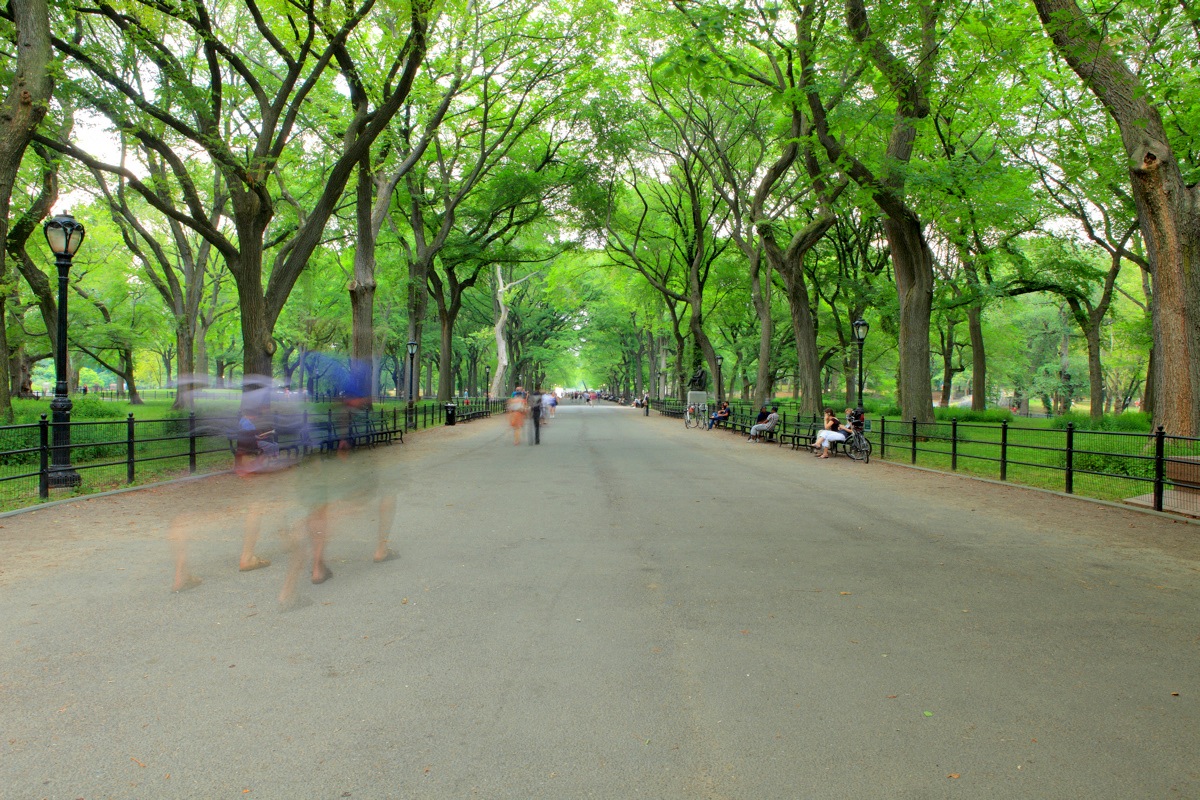
Here is another example. The photo below is of Literary Walk in Central Park, NYC. I wanted to get a clean shot of the walkway without any people in the foreground, but it is difficult as the path is often busy with groups enjoying the park. In this photo there are a couple of people walking through the shot on the left.
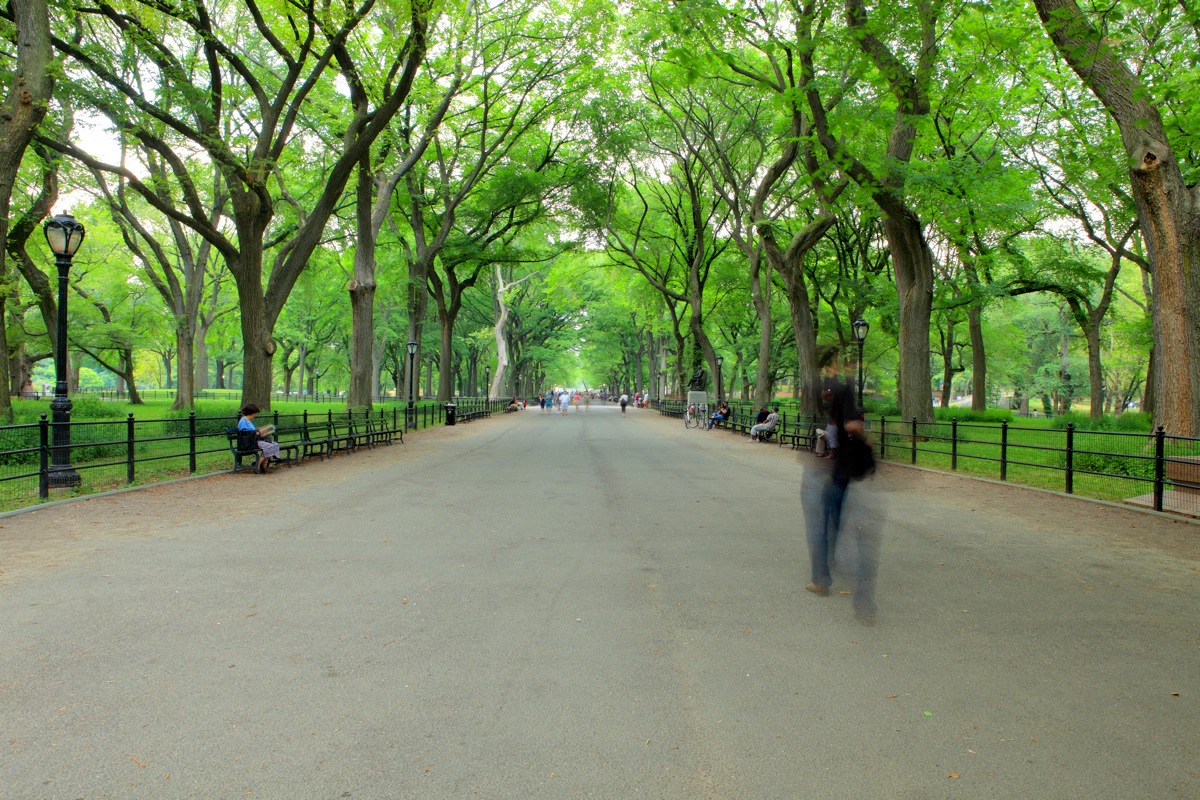
A minute later the people on the left had moved on, so I took another shot. The area was still busy and someone walked through the shot, but this time on the right side of the frame. See below:
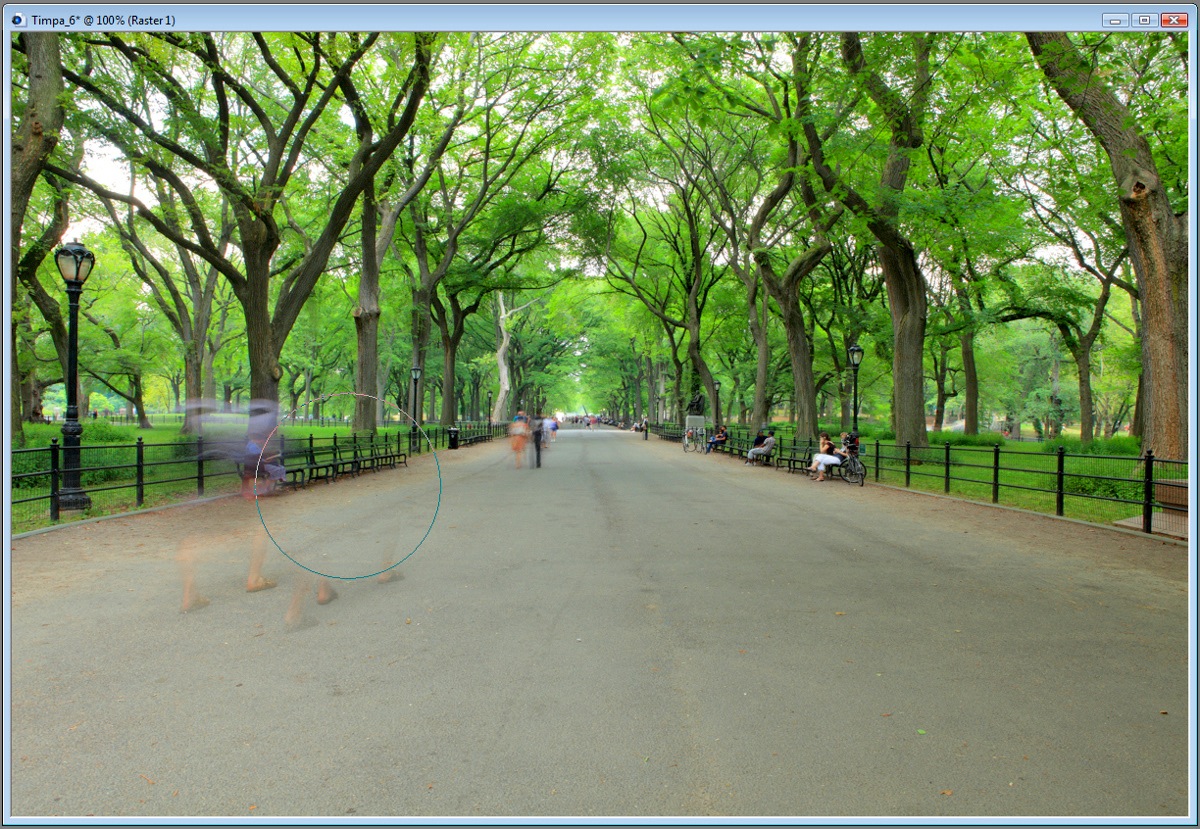
Here’s the shot after the first swipe with the eraser brush:
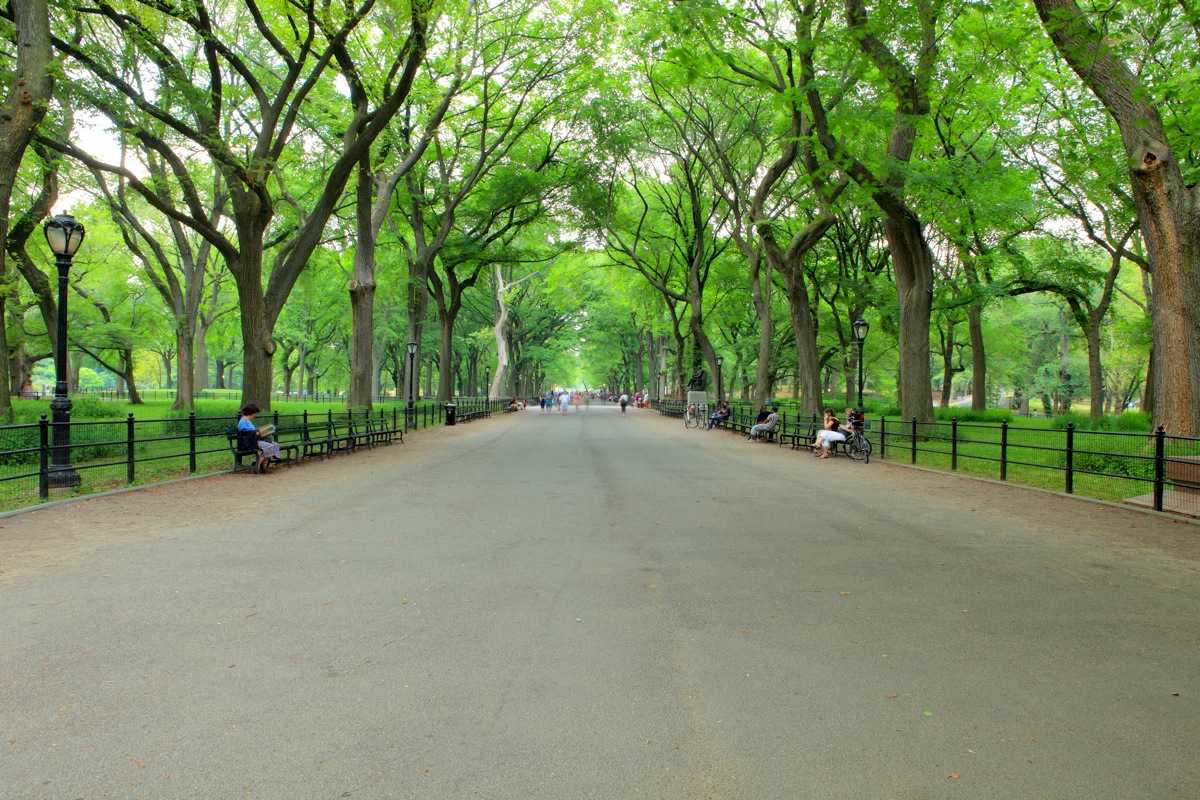
The final resulting photo is this:
Once you’ve mastered the technique, you’ll be able to quickly create distraction-free photos that really show off the beauty of the locations you’re photographing. Both the examples above took me less than a minute!
Paul Timpa is creator of the iPhone / Android app “Photography Trainer” which teaches users photography and he answers photography questions daily on his Facebook Page.
Post from: Digital Photography School


 "
"

However, it is not the only tool that offers instant answers. Wolfram Alpha, a search engine developed by Stephen Wolfram, can solve a much wider array of problems and unlike Google, it doesn’t require to type queries in any particular syntax. Here are some examples:
1. Your Location
A query like “where am i” will reveal your IP address and your current geographic location. Alternate queries that will get the same information about your computer include “who am i” and “what is my ip.”
2. Date and Time
You would normally need an Excel spreadsheet and may have to learn some formulas to perform basic calculations involving date and time but not with Wolfram Alpha. The tool lets you work with dates using natural English (similar to Outlook Calendar).
If you are to calculate the number of days before your next holiday, use “how many days until <holiday name>”. You can subtract dates like regular numbers or compute new dates with natural phrases like “second saturday of next month” or “now + 10 days.”
3. Food
Wolfram Alpha can instantly answer most of your food and nutrition related questions like how many calories are present in a bottle of Coke? Which is healthier – the french fries served at Burger King or the ones at McDonald’s?
4. Time Zones
You know that a query like “time in <city>” will display the current time of that city. This works for most search engines but Wolfram has an additional feature that works in reverse.
You can specify the time of any city and it will convert that time into your local timezone. This should be handy when a client suggests a meeting time using his timezone and you have to quickly figure out if that time works out for you.
Also see: A Less Confusing View of World Time Zones
5. Astronomy
If you are a fan of Astronomy, you’ll absolutely love Wolfram Alpha and it can compute the position of stars and planets for any given day.
The tool can tell you the exact dates for astronomical events like when the next solar eclipse will take place while a specific query like “solar eclipse in new york” will show you the date for the next eclipse that will be visible from New York.
6. Finance
Want to know the number of people who are working for a particular company. Wolfram Alpha can get this information and more using simple queries like “market cap of Apple” or “revenue of Google.” You may also use the tool to query past stock prices and indices.
7. Colors
What do you get when you pour some red paint in a bucket of yellow paint? What’s the HTML and RGB equivalent of Purple?
8. Comparisons
Wolfram|Alpha is an excellent tool for performing comparisons and it presents results in a neat table making it easy for you to interpret the data.
You may compare almost anything and everything from airports, universities, size of popular structures (Statue of Liberty vs Eiffel Tower), quantities (10 lb vs 12 kg), stock quotes, sales tax rates in various cities, sports teams, and even standard paper sizes.
9. Weather
Most search engines offer weather forecast for the next 7 or 10 days but with Wolfram Alpha, you can get historic weather conditions of a city as well for any given date.
And unlike Google which will only give you sunrise and sunset times for the next day, Wolfram Alpha can compute that information for any past and future date.
10. Understand Relations
This is one of my favorites. Put it any complex family relationship – like your mother’s sister’s son’s wife’s father – and Wolfram will map it into a genealogical tree making it easier for you make sense of that relation.
These are just some uses of the very-awesome Wolfram|Alpha. Do check this page for more examples and then go here to add Wolfram to your browser’s search box.
Also see: Display Wolfram Alpha results in Google


This article, titled Some Questions Can’t Be Answered by Google, was originally published at Digital Inspiration under Search, Wolfram, Internet.
"


 "
"
This post is from staff writer Sierra Black. Sierra writes about frugality, sustainable living, and getting her kids to eat kale at Childwild.com.
A few weeks ago I wrote about how money really can buy happiness — if you spend it right. A big-screen TV isn’t a ticket to happiness, but a vacation might be. Giving your money away can boost your well-being, and so can investing it in time with your family.
A new study from Princeton hangs a price tag on that happiness: $75,000 [PDF summary]. That’s the annual household income that gives you the most joy for your buck. People with incomes below that magic number report less happiness, overall, than those at or above it.
The effect levels off after $75,000, though. As your income increases, your cheerfulness also increases, but the good cheer plateaus around $75,000. Another $25,000 a year — or even another $100,000 a year — will make you richer, but it won’t make you much happier.
The magic number?
It’s not that $75,000 is enough money to let you buy anything you want. Anyone supporting a family on that salary knows you still have plenty of careful budgeting to do. Rather, it’s that Stuff doesn’t make you happy. A bigger income buys you more Stuff, but the emotional satisfaction of having it wears off quickly.
Why $75,000? Because that’s the magic number at which most Americans can pay their basic living expenses and have a little something left over for the good things they want in life. Or, as the Nobel-prize winning research team who ran the study put it:
More money does not necessarily buy more happiness, but less money is associated with emotional pain. Perhaps 75,000 dollars is a threshold beyond which further increase in income no longer improve individuals’ ability to do what matters most to their emotional well-being, such as spending time with people they like, avoiding pain and disease, and enjoying leisure.
They’re talking about the sense of day to day joy that comes into your life when you have Enough. If you’ve read Your Money or Your Life, you surely recall their graph of how money affects our moods. From poverty up through plenty, they chart a curve. At the peak, you have Enough: your living expenses are covered, your future is secure, and you have some fun money to spend on the things you enjoy.
Beyond Enough, the curve dives downward into clutter, stress, competition and an array of other sorry outcomes.

Sadly for us frugal types, the researchers didn’t find that to be true. Accruing more money won’t make you happier on a day-to-day basis, but the super-rich do score higher than the middle class on another axis of happiness.
Life assessment
The technical term for this one is “life assessment”, and it simply means how satisfied with your life you are overall. The wealthy see themselves as more successful than the middle class do even though their wealth doesn’t bring them joy.
Partly that’s because wealth allows them to achieve more of their dreams. I’d bet that part of it, too, is simply the high value our culture places on being rich. If everyone around you is striving to die with the biggest bank account, and you have it, you feel like a winner.
You don’t have to be super-rich to achieve your dreams and be satisfied with your life, though. Many people do that even on a fraction of the $75,000 it takes to get most of us to the Enough place.
They do it by knowing what they want, being disciplined with what they have, and celebrating their achievements. They’ve stepped far enough out of the cycle of consumption to stop wanting More More More all the time. They have Enough, at whatever salary they’re earning.
How do you find your own personal money Enough?
How much is Enough?
Knowing where you are is, as Your Money Or Your Life makes clear, essential. You need to know how much you earn, how much you have in assets and liabilities, and how much you’re likely to make during your career. You need to know this because without it, you can’t get clarity about what you want.
Knowing your net worth doesn’t automatically get you that clarity, though. You need to set an intention. For me, that process started with a brainstorming session with my partner. We laid out three categories of financial priorities:
Once we’d created this blueprint for managing our money, we got real specific. We want to fund our retirement. Great. How much do we need to retire on? What resources do we have to create that nest egg? We want our kids to have a great education. Great. What kind of education? How much will that cost?
By being specific about what we wanted, we were able to put a price tag on each of our goals. An overall picture emerged of what Enough would mean for us. In the parlance of this research I’ve been discussing, we were able to see what it would cost to buy our vision of happiness.
About $80,000 a year. Since we live in a fairly high cost-of-living city, so this number is well within range of the $75,000 Princeton’s scientists came up with when looking at the whole country.
The number is beside the point, though. What matters is the exercise of understanding your priorities, and knowing what your dreams cost. Whether you do this and discover that your personal Enough is $30,000 or $300,000, you’ll be better off for having a clear sense of what you’re striving for, financially.
I distilled all that complex brainstorming and math into a single index card. I keep it on my desk. It says, “My money Enough” at the top, and then lists the goals I’m working towards. It’s an inspiration when I’m tempted to slack off on my saving or my career.
---
Related Articles at Get Rich Slowly:


| Piled Higher & Deeper by Jorge Cham | www.phdcomics.com | |
 | ||
title: "Beard migration" - originally published 9/10/2010 For the latest news in PHD Comics, CLICK HERE! | ||

Super Mario Bros is 25 today, so here's a selection of facts and figures on the world's greatest platform hero…
It's the biggest game series of all time, and Super Mario is 25 years-old today. To celebrate, we've jammed together 25 snippets of Mario trivia. Don a pair of blue dungarees and adopt an inaccurate Italian accent, it's Mario time!
1. Mario was created by Shigeru Miyamoto and appeared in the game designer's first ever title, the 1981 arcade platformer, Donkey Kong. Miyamoto was hired as a graphic artist by Nintendo in 1977, and was given the task of designing a game after several of the company's early coin-ops had failed to make an impression on the lucrative arcade market. Donkey Kong was created using the hardware behind an older arcade title named Radar Scope, which sunk without a trace in the US. Miyamoto ditched the shooting theme and added an ape and rolling barrels. Success naturally followed.
2. Mario was originally known as Jumpman. However, when Nintendo's US office were trying to think of a better name in time for the American release of the game, they were interrupted by their landlord Mario Segale, after whom they christened the character.
3. Mario was originally a carpenter, not a plumber. He's also appeared as a doctor in the 1990 puzzle title Dr Mario and its sequels.
4. The look of Mario is all about the graphical limitations of the hardware at the time. He has a hat, because realistic hair was difficult to portray, a moustache to accentuate his nose, and dungarees to make his arm movements more noticeable. In Super Mario Bros, he wears a brown shirt below his overalls – a look that was swiftly abandoned.
5. Donkey Kong Jr, the 1982 sequel to Donkey Kong, is the only game in which Mario officially stars as the antagonist. He has trapped poor Donkey Kong in a cage and the ape's son must rescue him. In the game's promotional material, Mario even gets a specially twirled moustache, highlighting his evil nature.
6. In contrast, Bowser, the key antagonist of the Super Mario Bros series, has also appeared as a good guy. He helps Mario in the 1996 title Super Mario RPG: Legend of the Seven Stars.
7. Super Mario Bros was preceded by the 1983 arcade platformer, Mario Bros. Designed by Miyamoto and Game Boy-creator Gunpei Yokoi, it's set in the New York sewer system and introduces Mario's brother Luigi.
8. Bowser was originally sketched as an ox by Miyamoto, but his drawings were misinterpreted by animator Yoichi Kotabe as a turtle. The duo worked together on the latter idea and the Bowser we know today was born. He's definitely a turtle, though, and not a dragon as some assume. (More here.)
9. The naughty version of Mario – Wario – first appeared as a nemesis in the Game Boy title, Super Mario Land 2. He was designed by Hiroji Kiyotake, who also created Samus Aran, the heroine of the Metroid series. Wario's name blends Mario with the Japanese adjective 'warui' meaning evil.
10. The first Super Mario Bros game has sold 40.24 million copies, although that figure is skewed by the fact that it was bundled with the Nintendo Entertainment System console. It was until recently, however, considered the best-selling game of all time. It has been pushed into second place by Wii Sports on 41.65 million units.
11. Super Mario Bros was the first game to be set in Mushroom World, Miyamoto's long-running and ever-evolving fantasy kingdom. When Mario 'eats' a super mushroom he grows in size and ability. Miyamoto denies that he was influenced by Alice in Wonderland, and instead claims the idea came from enchanted foodstuffs in myths and folklore.
12. In the 1984 Nintendo Entertainment System game Golf, Mario made his first appearance in a sports sim. Kind of. The original character merely resembled Mario, while the later NES Open Tournament Golf specifically featured Mario as a golfer. He appears on the cover in red and white striped overalls, with a blue starry shirt. An awesome outfit.
13. Nintendo composer Koji Kondo provided the iconic soundtrack to Super Mario Bros. The main theme, known as 'Ground Theme', is one of the most recognisable pieces of game music ever recorded. The tune remained in the Billboard ringtone charts for 125 weeks and has been performed in concert by live orchestras. (More here.)
14. The original Super Mario Bros 2 was designed as a tougher version of the first game and released to support the Famicom Disk System, a new add-on for the Japanese version of the Nintendo Entertainment System. It was considered too difficult for Western release, though, so the US and Europe got a tweaked version of the 1987 title Yume Kojo: Doki Doki Panic instead. The game was hastily refitted with Mario characters in a sort of digital cut-and-shut job. In 1993, the genuine SMB2 was finally released in the West as Super Mario Bros: the Lost Levels, part of the Super Mario All-Stars collection.
15. A Q Score survey in the early nineties revealed that Mario was more recognisable to American children than Mickey Mouse.
16. Footage from Super Mario Bros 3 appears in the climatic scene of appalling 1989 movie, The Wizard, about an emotionally withdrawn gaming champion. As this was the first chance that US Nintendo fanatics would get to see the game, the movie effectively acted as an advert for the release.
17. The new Chain Chomp enemies in Super Mario Bros 3 look like steel black balls with razor sharp teeth. They were inspired by an incident in Miyamoto's childhood when a neighbour's dog chased the terrified genius, before it was yanked back by its chain.
18. Elsewhere, the Whomp characters from Super Mario 64 were inspired by a mythological being known as the nurikabe, a 'wall ghost' that misdirects or impedes travellers at night.
19. ...and the versions of the ghostly Boo enemies found in Super Mario 64, are based on the wife of the game's co-designer Takashi Tezuka. As Miyamoto explained in an interview with Nintendo Power magazine: 'Mr. Tezuka got an idea about putting his wife in the game. His wife is very quiet normally, but one day she exploded, maddened by all the time he spent at work. In the game, there is now a character who shrinks when Mario looks at it, but when Mario turns away, it will grow large and menacing.'
20. Released in 1989, the Game Boy title Super Mario Land was the first major Mario game to be developed without Miyamoto. Producer Gunpei Yokoi didn't do too badly however: the game shifted over 18 million copies. The game also introduces a new female character, Princess Daisy, replacing Mario's usual love interest, Princess Peach.
21. The 1993 movie, Super Mario Bros, was Hollywood's first attempt to create a video game tie-in. Starring Bob Hoskins and Dennis Hopper it was a critical and commercial failure, which attempted to give the game a darker, more adult veneer. Apparently, Dustin Hoffman was interested in the role of Mario as his children were fans of the game.
22. Since 1995, the voice of Mario has been provided by American voice actor Charles Martinet. He also voices Wario and Luigi.
23. The Wii hit Super Mario Galaxy was inspired by a tech demo known as Super Mario 128 shown at the Nintendo Space World event in 2000. The demo showed dozens of teeny Marios walking around on a slightly curved surface. During the Gamecube era Galaxy designer Yoshiaki Koizumi thought that entirely spherical levels would make an interesting environment for Mario, but Miyamoto was apparently unconvinced at first. Finally, Koizumi showed off several test levels and the project was greenlit for Wii.
24. The Super Mario bros series is in the Guinness Book of Records as the most successful gaming franchise of all time. It now boasts global sales of over 240 million units.
25. Mario has appeared in over 200 video games.