sexta-feira, 26 de fevereiro de 2010

Making Money Alert

By: Doug Fabian | Editor, Successful Investing | President, Fabian Wealth Strategies
The Black Cross Society 

In technical analysis parlance, a black cross (sometimes known as a death cross) occurs when an index’s falling 50-day moving average meets its rising 200-day moving average. And as the ominous name suggests, this is not a positive development for a sector. In fact, it usually signals the return of a very serious bear market.

Well, let’s take a look at the chart below of the iShares FTSE/Xinhua China 25, the key index that measures the health of China’s stock market. As you can see, the 50-day moving average (blue line) has fallen down to just about where the 200-day moving average (red line) has climbed.


This near black cross could be a very bad sign for stocks in what until recently has been one of the hottest financial markets in the world. If we do see this black cross take place on FXI, then inverse exchange-traded funds (ETFs) that move higher when the Chinese market falls will be the place to collect some really big profits.


Back Home in the U.S.A. 

Back home in the U.S.A., we have a much different technical picture. After sinking below its 50-day moving average, the S&P 500 Index now has fought its way back to the 50-day average. But before this broad measure of the markets can break through this short-term, technical resistance mark, we’ll have to see a lot more buying on convincing trading volume.


In my ideal market world, I would like to see the S&P 500 pull back to its long-term, 200-day moving average. I think that kind of shakeout would set investors up for a very nice buying opportunity. So, if you’ve been waiting to put money to work, then I would certainly recommend that you stay patient and wait to see if we do get that most-advantageous market pullback.

Of course, there is more to assessing the markets than just the S&P 500. Two other key measures I’ve been telling you about during the past several months are the value of the U.S. dollar vs. rival foreign currencies, and the direction of long-term Treasury bond yields.

In the chart below, we see that the U.S. dollar has mounted an impressive rally since it hit its December lows.


The move higher in the greenback is not good news for international equities and, as such, it behooves you to make sure you don’t have a lot of international equity exposure in your portfolio right now.

Finally, we can see that yields also have been on the move since December. The chart below shows the 30-Year T-Bond Yield just below its 52-week high.


The surge in yields, and the concomitant decline in long-term Treasury bond prices, tells us that there is tepid demand for bonds. This halfhearted demand for buyers means bond yields likely will continue rising. It also means that if you are a big holder of U.S. Treasury bonds, you might want to think about setting a stop loss on your positions to protect yourself against a further decline in bond prices. 

Better Gmail Search


Better Gmail Search

from Google Operating System 

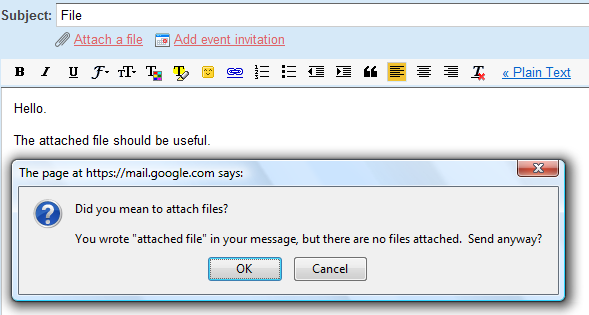
Gmail's blog announced that 6 labs features have graduated (Search Autocomplete, Go To Label, Forgotten Attachment Detector, YouTube Previews, Custom Label Colors, Vacation Dates), while 5 other features are retired from Gmail Labs (Muzzle, Fixed Width Font, Email Addict, Location in Signature, Random Signature). Google says that "these decisions were made based based mainly on usage," so that's the reason why obscure features like Muzzle, a quick way to hide Gmail chat status messages, or Email Addict, which blocked Gmail's interface for 15 minutes, were removed.

The good news is that 2 labs features will greatly improve Gmail search: "Search Autocomplete" and "Go To Label". If you have many labels, it's difficult to find one of your labels, especially if you added the label to the "more" dropdown. "Go To Label" adds a keyboard shortcut that lets you quickly open a label: type "g l" and then type the first letters of the label you want to find.


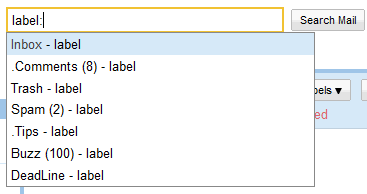
Gmail integrated "Go To Label" with the search box, so the keyboard shortcut only adds "label:" to the search box. If you don't like keyboard shortcuts, just type "label:" in the search box, followed by the first letters of a label.

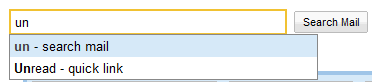
The autocomplete feature is not useful only when you want to open a label you've created. You can also use it for built-in labels like "unread", "starred", "chat", "buzz", "muted". Type the first letters of the word "unread" and you should find a quick link that shows all your unread messages.


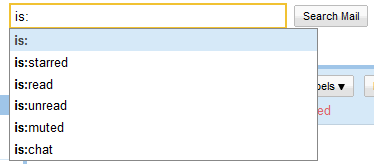
If you use Gmail's advanced search operators, the autocomplete feature shows common values for the operators. Type the "is" operator and Gmail shows a list of built-in labels.


Gmail's search box lets you restrict the results to messages that have attachments or to messages that include a certain type of attachment. Type "has" and you'll see a list of options that show messages with photo attachments, documents, videos or calendar events. You can also type natural language queries like: "photos", "documents", "attachments".


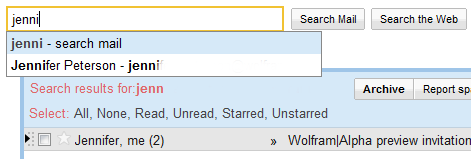
The search box is now the quickest way to find messages from one of your contacts: type the name of a contact or only the first letters from the name and you can read all the conversation with that person. If you want to restrict the results to the messages received from a contact, type "from:" before entering the name.


The other 4 graduated features have a more limited use:

* "Attachment Detector" shows a warning when you use words like "attached", "attachment" in a message without actually attaching a file.


* "YouTube Previews" lets you watch inside Gmail the YouTube videos linked from a message.

* "Custom Label Colors" is useful if you have many labels and the 24 color combinations offered by Gmail aren't enough.

* "Vacation Dates" improves Gmail's vacation responder by adding the option to enter the first day and the last day of your vacation.

quinta-feira, 18 de fevereiro de 2010

ALERT 02/17/10: A Tale of Two Markets


Doug Fabian's
Making Money Alert
MakingMoneyAlert.com | Fabian.comWednesday, February 17, 2010
DOUG FABIAN'S MAKING MONEY ALERT
In This Issue:
» NEW! Video Alert
» A Tale of Two Markets
» Consulting My CPA
» ETF Talk: Europe's Worrisome Debt
» Don't Be a Mutual Fund Dinosaur
» A Little Tax Humor 
By: Doug Fabian | Editor, Successful Investing | President, Fabian Wealth Strategies
 
A Tale of Two Markets 
 
Last week, we witnessed the U.S. equity markets make a solid push higher, and we now are trading well above the February lows. In fact, we now are trading right below the key, 50-day moving average (blue line) on the S&P 500 Index (see chart below). I suspect that this market, indeed, may blow past this short-term technical indicator and, if it does, it likely will signal at least the temporary retreat of those bears that came out so forcefully in January.

If we do break above the 50-day moving average, it will not mean you should add money to stocks immediately. In fact, I would love to see more selling back toward the longer-term, 200-day moving average (red line) before I commit any significant long-term investment capital to equities.


The current “trade location,” as I often call the entry point, is just not that favorable in U.S. stocks, especially considering the volatility we’ve seen during the past four-plus weeks. I think if you are waiting to get back into U.S. stocks here, you might want to just continue being patient and wait things out to see if we do, in fact, break well above the 50-day average. If we see some strong-conviction buying here, then it might signal the all-clear sign. But until we see that conviction, I recommend that you stay patient and wait for a better entry point.

Sponsored Content
Recovery a major DUD -- what to do...

A shocking new report out earlier this week gives the lie to the government-endorsed myth that the worst is behind us.

Official figures out of Europe show that the Eurozone barely had a pulse. The news from the U.S. wasn't much better: Foreign investors are recoiling in horror from Washington's spending and borrowing spree.

No wonder so many Americans are FED UP with Washington and Wall Street!

Click here to register for our FREE briefing with our NEW predictions for what's ahead...

So much for U.S. stocks, but what about the fortunes of one of the leading foreign markets in the world, China? As you likely know, that country’s equity markets have had a very rough go of it lately, as can be seen by the chart below of the iShares FTSE/Xinhua 25 (FXI).


This measure of the top 25 stocks listed on the Hong Kong exchange now trades below both its 50- and 200-day moving averages. And, while you could say that this is better trade location, i.e., a better entry point for capital vs. U.S. equities, I think you have to put the China pullback into its wider context.

That country has sold off lately on two big increases in bank reserve requirements during the last month or so, and fears of a bursting China bubble still haunt the equities market. While I do not yet know whether China is through turning down the spigot on its monetary stimulus, I do know that the worry over slower economic growth in that country, indeed, has contributed to the very sharp sell-off in its equity markets.

All year, I’ve been telling you to watch China, as it could be the proverbial canary in the coal mine that gives us the heads up on a wider global sell-off. So far in 2010, we have received strong signals that things are going to be tough for the bulls.

Will this China selling continue, and/or will the U.S. markets manage to come out of their funk before long? We’ll continue watching this tale of two markets for complete details -- and for the green light to put money to work in both domestic and international equities.


Consulting My CPA 

It’s now February, and that means tax season is in full swing. During the past week, I’ve been working particularly hard on my own tax situation, and I’ve been meeting regularly with my CPA, Lee Haight. Now, you may remember the excellent article that Lee wrote about taxes last December.

Sponsored Content
Another Market Meltdown Looms...

Don't believe the hopeful numbers, another market meltdown looms...

But the crash will be followed by a new market entry point that will see the market soar by 200% to 300%. I'll tell you when to dive in.

Click here to learn more.

In that article, Lee showed you how to make the most of your year-end tax planning by getting out in front of some of the rule changes slated for 2010. Those rules are numerous, and much more voluminous than one can cover in a short article.

So, to help you plan even further for this year’s taxes, I’ve invited Lee to be my guest this Saturday on my radio show, Making Money with Doug Fabian.

In what promises to be a most insightful hour, Lee will tell you how best to prepare for this year’s taxes -- taxes that are due in less than two months!

If you want to find out how a real professional approaches things this time of year, then you must listen to the show on Saturday.

To prepare for the show, or if you just want to hear my discussion with Lee right now, then I have a special treat for you. Last week, I conducted an interview with Lee, recorded it, and I now have made that interview available at DougFabian.com.

If you want to find out what you need to be doing right now to get yourself prepared for April 15, then I highly recommend that you listen to this interview now.


ETF Talk: Europe’s Worrisome Debt 

Greece’s fiscal woes have dominated the news in recent weeks but what you may not know is how to profit from the news. Although the European Union has promised to address the situation, Greece is not the only European country currently struggling with its debt load. The fiscally faltering countries to watch are Europe’s so-called PIIGS -- Portugal, Ireland, Italy, Greece and Spain.

Investors worried about potential fiscal meltdowns in these countries may want to take a well-diversified, international position to avoid fallout from potential financial bloodletting among the PIIGS. One way to do so is by investing in iShares MSCI EAFE Index (EFA). This exchange-traded fund (ETF) seeks to provide investment results that correspond generally to the price and yield performance, before fees and expenses, of publicly traded securities in the European, Australasian, and Far Eastern markets that are tracked by the MSCI EAFE Index. EFA currently is not one of my recommendations but it is a fund that offers limited exposure to the troubled PIIGS. The fund focuses on the developed markets that generally are protected from dire debt woes.


The biggest holdings in EFA, as of the end of January, were in Japan, 22.11%; the United Kingdom, 21.37%; France, 10.06%; Australia, 8.16%; Switzerland, 7.82%; and Germany, 7.66%. Two of the PIIGS, Spain, 4.3%, and Italy, 3.29%, follow. With only limited exposure to the PIIGS, the fund offers a chance to benefit from international exposure without taking excessive risk.

Key sectors held by the fund at the end of January were financials, 25.09%; industrials, 11.58%; consumer staples, 10.28%; materials, 9.86%; consumer discretionary, 9.82%; and health care, 8.42%. That degree of sector diversification helps insulate the fund from an overdependence on the performance of a given industry.

Sponsored Content
5 Forecasts Investors Need to Know Before March 1

Let’s face it. Every investor is in the midst of a battle. It’s a battle for your hard-earned wealth, and so far, you’re not winning.

The steps the Federal government is taking to reignite the economy are good for Wall Street banks and big corporations, but they’re not good for you and your wealth.

But you can change your future. There are 5 critical forecasts that every investor needs to know before March 1 to protect their wealth.  Heed my warnings and follow my advice and you could successfully build a fortress around your wealth and become two to three times richer.

Click here to discover how to build your wealth fortress today.

The stocks that composed the biggest shares of the portfolio’s positions, at the end of January, were HSBC Holdings PLC, 1.91%; BP PLC, 1.8%; Nestle SA-REG, 1.7%; Total SA, 1.26%; Roche Holding AG-Genusschein, 1.22%; and BHP Billiton Ltd., 1.2%. Clearly, an individual company does not account for an inordinate part of the fund’s performance. The lack of concentration in any particular position should reassure investors who do not want the fund to be dependent on one geographic region, industry or specific company.

If you think the market’s rebound during the past few days is the start of a trend, EFA offers a way to tap future gains. Its diversification also limits the fund’s risk. With market conditions remaining volatile, protecting your assets should be one of your top considerations.

Do you want advice about which ETFs to buy and to sell? If so, please sign up for myETF Trader service by clicking here. As always, I am pleased to answer your questions about ETFs, so do not hesitate to email me if you have one. To send an ETF question to me, simply click here. You may see your question answered in a future ETF Talk.


Don’t Be a Mutual Fund Dinosaur 

Does your investment strategy still consist of buying and holding mutual funds? If so, then you might be considered a “mutual fund dinosaur.”

You see, with the volatility we’ve seen in the markets over the past couple of years, and with innovative products such as exchange-traded funds now heavily populating the investment landscape, a failure to evolve from investing in primitive mutual funds could have your assets going the way of the dinosaurs.

In my latest radio show, broadcast Feb. 13, my sons David and Michael stood in for me and devoted nearly the entire hour to a discussion of mutual funds. They explained that in many cases, mutual funds just aren’t serving investors the way they should. They also explained that for many investors, exchange-traded funds are the much better investment option.

If you’re primarily a mutual fund investor, or if you own any mutual funds right now, you need to listen to this most informative -- and most entertaining -- broadcast hour. To listen to this episode, click here.


A Little Tax Humor 

“I’m proud to pay taxes in the United States; the only thing is, I could be just as proud for half the money.”

--Arthur Godfrey

The late, great humorist pretty much hit the nail on the head with his comedic insights into our tax system. I’d venture to say that most of us don’t mind paying our fair share for the country’s expenditures, but what we really don’t want to be is overtaxed.

Wisdom about money, investing and life can be found anywhere. If you have a good quote you’d like me to share with your fellow Alert readers, send it to me, along with any comments, questions and suggestions you have about my radio show, newsletters, seminars or anything else. Click here to Ask Doug.

Sincerely,

Doug Fabian


On Fiscal Follies and Economic Ne'er-Do-Wells


Nicholas Vardy's The Global Guru
February 16 , 2010
Vol. 5, No.7

Fellow Investor,

On Fiscal Follies and Economic Ne'er-Do-Wells

Every year, at least one member of the European Union seems to earn the title of economic ne'er-do-well, the collapse of its economy threatening the utopian project of European integration. Last year, it was Hungary and the Baltic states of Estonia, Latvia and Lithuania. This year, it is Greece that is grabbing the headlines. Since the country's perilous fiscal position came to light, Greece has become the global poster child for fiscal irresponsibility.

Sponsored Content
Tick, Tick, Tick… It's Time to Buy!


Despite the Dow hitting 10,000, and no matter whether the DOW ends the year at 11,000 or 9,000, savvy investors interested in more-certain profits are banking that global markets, and the "other China" in particular, will continue to beat the pants off of Wall Street.

While many advisors will tell you that China is the place to park your money, I'm here to tell you that there's an even better way to cash in on China's booming economy!

Click here to discover an emerging economy that's stable, modern, westernized, and even more attractive than China's.

As remote as it may seem to the United States' own economic problems, how Greece ultimately resolves its fiscal woes offers important lessons on what the U.S. government needs to do to avoid a similar fiscal train wreck -- even as that train is heading down the track toward us with ever-accelerating speed.

Greece: Europe's Ne'er-Do-Well of 2010

Greece's accession to the eurozone -- that is, abandonment of its own currency in favor of the euro -- was always viewed as a kind of economic affirmative action. Greece's lack of genuine economic achievements and transparent statistical sleight of hand, which added 25% to Greece's GDP overnight, was dismissed by European bureaucrats with a wink and nod. Best intentions notwithstanding, admitting Greece to the eurozone did nothing to change its centuries-long culture of government entitlements, lackadaisical tax collection, and widespread practice of petty graft and corruption.

Yet, should the European bureaucrats who are now castigating Greece be surprised? As Carmen Reinhart and Ken Rogoff demonstrated in This Time is Different: Eight Centuries of Financial Folly, Greece has been in default roughly one out of every two years since it first gained independence in the nineteenth century.

The United States: The Planet's Ne'er-Do-Well of the Next Decade

Here's the irony. By any objective measure, the U.S. government is in much worse shape than Greece. Greece and the U.S. government's fiscal deficits of 12.7% in 2009 are virtually identical. Yet, while Europe is going apoplectic over whether Greece will meet its objective of reducing its deficit by 2012 to 3% of GDP, an austerity program of similar proportion in the United States is unthinkable.

Unlike Greece, the Obama administration's proposed budget for 2010 shows it is in complete denial. There are a handful of factors -- the inexorable impetus of demographics, the miracle of compound interest and the growing role of government -- that cannot be ignored, no matter what your political persuasion. The fiscal situation of the United States combines all three of these factors and gives the formerly fringe, doom-and-gloom crowd newfound "street cred." And, looked at from the outside, the emerging culture of government entitlements and subsidies in the United States is scarcely different from the benefits enjoyed by Greek workers. As recently as 2007, the Transportation Department had only one person making $170,000 or more a year. Today, it has 1,690. Don't bother telling your kid to study hard so she can go to Harvard or Stanford Law School and to get a job at a top Wall Street Law firm. Chances are, she'd be better paid as a pencil pusher for the government.

How Hungary and New York City Got It Right

The irony is that despite a long tradition of fiscal profligacy, Greece's chance of solving its fiscal problems is much higher than the United States solving its own. The United States does not have the pressure of 15 other larger economies shoehorning it into economic austerity. And, the U.S. economy is a supertanker, compared to a speedboat that is Greece. When their backs are up against the wall, spending cuts and reforms in small countries can happen quickly.

Take the example of Hungary, last year's European bad boy. For all of the disfunction of that country's political system, when push came to shove, Hungary was able to call the political equivalent of a "time out" among incessantly squabbling political parties and appoint a technocratic government that pushed through otherwise politically unacceptable spending cuts. As a result, the country was able, with the help of the IMF, to pull back from economic collapse. By all objective measures, Hungary's Prime Minister Gordon Bajnai, a former colleague of mine, engineered an impressive (and frankly, surprisingly successful) turnaround. His reward? He's one of the most hated men in the country.

Sponsored Content
The Crash of 2010 Is Coming


We're in the midst of The Mother of All Sucker's Rallies. But those who aren't fooled by it can avoid the coming crash – and take advantage of the incredible buying opportunity that follows.

Read on to learn more – including how to receive 3 wealth-building Investor's Guides PLUS an investor's seminar on video, all FREE (a combined $555 value).

Click here for full details.

That's not a risk an approval-seeking Barack Obama would ever take. New York City offers the best example of what the federal government would have to do to avoid Greece's fate. Mayor Michael Bloomberg's New York is now facing a staggering $4.9-billion deficit. As with U.S. government workers, New York City public salaries skyrocketed, with teachers enjoying a 43% increase in the last few years. In response, Bloomberg has proposed austerity measures like closing Manhattan swimming pools. Presumably, New York City teachers can now afford their own.

It is tempting to assert that if Bloomberg, a Democrat who is also an ex-businessman, was sitting in the White House, the federal government budget for 2010 would not include a projected deficit of $1.3 trillion. Nor is this a matter of which party's lever you pull when you go into the voting booth. Contrast Bloomberg's response to his fiscal crisis with that of a Republican bodybuilder-turned-actor at the helm of California or a Democratic political parvenu whose modest mastery of rhythmic cadences landed him in the White House.

Sadly, while Mayor Michael Bloomberg can make the necessary spending cuts in New York City, and Prime Minister Gordon Bajnai could do so in a small country like Hungary, it's unlikely to ever happen in the U.S. federal government. Although I am convinced that Greece eventually will do the right thing, the current crisis also shows how quickly things can get out of control. Once a country loses its credibility, things can head south very quickly.

Sponsored Content
Alpha Traders Are Buying This Now... You Should Too


Discover the secrets of Alpha Traders… and shoot for 48% annualized returns (like I've been getting since 2005).

Now the Alpha Traders are taking aim on new trades… trades so profitable that I'll guarantee you at least 7 triple-digit winners in the next 12 months!

Click here for details

And sadly, there is no Germany or IMF to bail out Washington, D.C.

Sincerely,

Nicholas A. Vardy
Editor, The Global Guru

THIS WEEK IN SCIENCE - February 19 2010

From Big Fish to Big Whales


Figure 
1
CREDIT: ©ROBERT NICHOLLS, PALAEOCREATIONS
Whales are the largest animals today, and many feed on the abundant plankton, particularly diatoms, in the oceans. Whales arose and diversified in the Cenozoic, about 30 to 40 million years ago (see the Perspective by Cavin). Marx and Uhen (p. 993) show that their diversity parallels the diversity of diatoms and changes in ocean temperature. Whether there were large predators of plankton before whales has been enigmatic, because the fossil record during the Mesozoic (245 to 65 million years ago) is sparse. Friedman et al. (p. 990) now show that a group of large fish filled this role for nearly 100 million years in the Mesozoic. Although not as large as whales, these globally distributed fish were still several meters long. Their extinction at the Cretaceous-Paleogene boundary 65.5 million years ago may have cleared the seas for the evolution of whales.


To Degrade or Not to Degrade

Regulating the turnover of proteins within the cell is of fundamental importance to almost every physiological process. Hwang et al. (p. 973, published online 28 January; see the Perspective by Mogk and Bukau) now find that acetylated N-terminal methionine (Met) is a degradation signal. This degron is recognized by Saccharomyces cerevisiae Doa10, a transmembrane E3 ubiquitin ligase that resides in the endoplasmic reticulum and inner nuclear membrane. The removal of N-terminal Met by Met-aminopeptidases generates N-terminal residues that are often N-terminally acetylated. Doa10 selectively binds to the resulting N-degrons, which may represent the most prevalent class of cellular protein degradation signals.


2D Quantum Critical Transitions

Quantum critical transitions occur at near-zero temperatures when the properties of quantum matter are tuned by an external parameter such as the magnetic field or pressure. Heavy fermion materials, which have effective charge carrier masses hundreds of times heavier than the bare electron mass, have emerged as a prototypical system for studying these transitions. Now, Shishido et al. (p. 980; see the Perspective by Coleman) use a heavy fermion compound to experimentally realize a new type of quantum phase transition where the tuning parameter is the dimensionality of the system. They engineer a family of superlattices made up of a fixed number of layers of the conventional metal LaIn3 and varying numbers of layers of the heavy fermion material CeIn3. As the number of layers of CeIn3 is decreased, the system gradually changes character from three- to two-dimensional, with corresponding changes in its transport properties.


Detecting Distant Planets

More than 400 planets have been detected outside the solar system, most of which have masses similar to that of the gas giant planet, Jupiter. Borucki et al. (p. 977, published online 7 January) summarize the planetary findings derived from the first six weeks of observations with the Kepler mission whose objective is to search for and determine the frequency of Earth-like planets in the habitable zones of other stars. The results include the detection of five new exoplanets, which confirm the existence of planets with densities substantially lower than those predicted for gas giant planets.


Silicate in the Primordial Soup

Direct evidence for how prebiotic synthesis of complex organic molecules paved the way for the origin of life is extremely scarce. Thus, studies are mainly limited to controlled simulations of likely reactions in early Earth conditions. Similarly, chemical reactions in the laboratory may generate the products necessary for biosynthesis, but may nevertheless be geochemically irrelevant. Lambert et al. (p. 984) show that silicate ions, present in Earth's surface waters at relatively high concentrations, catalyze the formation of four- and six-carbon sugars from simple sugars via the formose reaction. The resulting complexes stabilize the sugar molecules, allowing sugars to accumulate in greater abundance. Silicate stabilization also circumvents the need for the formose reaction to proceed at high temperatures, thus extending the range of possible environments in which life could have originated.


Acid Assistance


Figure 
1
CREDIT: XU ET AL.
Protons are quite versatile catalysts of organic reactions, but because they are achiral, they cannot induce stereoselectivity on their own. One productive way around this problem has been to use chiral conjugate bases and perform reactions in media where the bases remain tightly attracted to protonated substrates. Xu et al. (p. 986; see the Perspective by Schreiner) thoroughly explored the mechanism of an alternative approach, in which an achiral acid was used in conjunction with a second, chiral molecule (a urea derivative) for catalysis. High selectivity was attained with this method in the coupling of aryl imines with olefins. Extensive kinetic and computational studies showed that the acid and its chiral partner acted cooperatively in binding the substrates, optimizing the tradeoff between speed and selectivity.


Metabolic Regulation Through Acetylation

Covalent modification of lysine residues in various proteins in the nucleus is a recognized mechanism for control of transcription. Now two papers suggest that acetylation may represent an important regulatory mechanism controlling the function of metabolic enzymes (see the Perspective by Norvell and McMahon). Zhao et al. (p. 1000) found that a large proportion of enzymes in various metabolic pathways were acetylated in human liver cells. Acetylation regulated various enzymes by distinct mechanisms, directly activating some, inhibiting one, and controlling the stability of another. Control of metabolism by acetylation appears to be evolutionarily conserved: Wang et al. (p. 1004) found that the ability of the bacterium Salmonella entericum to optimize growth on distinct carbon sources required differential acetylation of key metabolic enzymes, thus controlling flux through metabolic pathways.


Cropland Acidification in China

China is experiencing increasing problems with acid rain, groundwater pollution, and nitrous oxide emissions. Rapid development of industry and transportation has accelerated nitrate (N) emissions to the atmosphere. Consequently, soil degradation, water shortage, and pollution, in addition to atmospheric quality decline are becoming major public concerns across China. Since the 1990s, China has become both the largest consumer of chemical N fertilizers and the highest cereal producer in the world, which has consequences for arable soil acidification. Guo et al. (p. 1008, published online 11 February) present a meta-analysis of a regional acidification phenomenon in Chinese arable soils that is largely associated with higher N fertilization and higher crop production. Such large-scale soil acidification is likely to threaten the sustainability of agriculture and affect the biogeochemical cycles of nutrients and also toxic elements in soils.


Predictable Travel Routines


Figure 
1
CREDIT: SONG ET AL.
While people rarely perceive their actions to be random, current models of human activity are fundamentally stochastic. Processes that rely on human mobility patterns, like the prediction of new epidemics, traffic engineering, or city planning, could benefit from highly accurate predictive models. To investigate the predictability of human dynamics, Song et al. (p. 1018) used the recorded trajectories of millions of mobile phone users, collected by mobile phone companies and anonymized for research purposes. They hypothesized that given the wide range of travel patterns that different users follow, there would be significant differences between their predictability as well: Users who travel less should be easier to predict than those who are constantly on the road. Surprisingly, there was 93% predictability across the whole user base, and individuals' predictability did not in general fall significantly below 80%.


Killing Pseudomonas

Gram-negative Pseudomonas bacteria are opportunistic pathogens, and drug-resistant strains present a serious health problem. Srinivas et al. (p. 1010) synthesized a family of peptidomimetic antibiotics that is active only against Pseudomonas. These antibiotics do not lyse the cell membrane, but instead target an essential outer membrane protein, LptD, which plays a role in the assembly of lipopolysaccharide in the outer cell membrane. Activity in a mouse infection model suggests that the antibiotics might have therapeutic potential. In addition, LptD is widely distributed in gram-negative bacteria and so its validation as a target has the potential to drive development of antibiotics with a broader spectrum of activity against gram-negative pathogens.


Examining the Backbone

Determination of tertiary protein structures by nuclear magnetic resonance (NMR) currently relies heavily on side-chain NMR data. The assignment of side-chain atoms is challenging. In addition, proteins larger than 15 kilodaltons (kD) must be deuterated to improve resolution and this eliminates the possibility of measuring long-range interproton distance constraints. Now Raman et al. (p. 1014, published online 4 February) use backbone-only NMR data—chemical shifts, residual dipolar coupling, and backbone amide proton distances—available from highly deuterated proteins to guide conformational searching in the Rosetta structure prediction protocol. Using this new protocol, they were able to generate accurate structures for proteins of up to 25 kD.


Histones and Alternative Splicing

Alternative splicing—the inclusion of different combinations of gene exons within a messenger RNA transcript—occurs in the majority of human genes and is regulated by basal and tissue-specific splicing factors, by transcription kinetics, and by chromatin structure. Luco et al. (p. 996, published online 4 February) analyzed the alternative splicing of the human fibroblast growth factor receptor 2 gene in tissue culture cells and found that inclusion of exon IIIb or IIIc was modulated by the levels of histone H3 lysine 36 trimethylation (H3-K36me3) and H3-K4me3. Histone H3-K36me3 enrichment correlated with binding of the chromatin protein, MRG15. The MRG15 protein in turn recruited the polypyrimidine tract–binding protein (PTB) splicing factor, which acts to repress alternative exon inclusion, thus establishing a direct link between histone modifications and the splicing machinery.

domingo, 14 de fevereiro de 2010

Pink Floyd - Wish You Were Here (live)


So, so you think you can tell Heaven from Hell,
blue skies from pain.
Can you tell a green field from a cold steel rail?
A smile from a veil?
Do you think you can tell?
And did they get you to trade your heroes for ghosts?
Hot ashes for trees?
Hot air for a cool breeze?
Cold comfort for change?
And did you exchange a walk on part in the war for a lead role in a cage?
How I wish, how I wish you were here.
We're just two lost souls swimming in a fish bowl, year after year,
Running over the same old ground.
What have you found? The same old fears.
Wish you were here.

sábado, 13 de fevereiro de 2010

Between Dire and Disastrous

Thoughts from the Frontline Weekly Newsletter
Between Dire and Disastrous
by John Mauldin
February 12, 2010
Visit John's Home Page
In this issue:
A Path-Dependent World
Between Dire and Disastrous
A National Suicide Pact
It's More than Just Greece
R.I.P., Walt Ratterman
The NBA, Snow, and No Power


The news is somewhat "All Greece, All the Time," but most of the pieces miss the more critical elements, and in today's letter we will look at what I think those are, as well as at the important point that Greece is a precursor of a new era of sovereign risk. Plus, we glance at a few rather silly recent comments from economists. It will make for a very interesting discussion.
A few weeks ago I mentioned my friend Sir Walt Ratterman, who was in Haiti at the time of the earthquake. Long-time readers know that every Christmas I ask you to make a donation to Knightsbridge and projects that Walt runs. You have been very generous over the years. Tragically, they have found Walt's body. For those interested, I will provide a few details about this true hero, toward the conclusion of the letter.
Before we get into the meat of the letter, I want to give you a chance to register for my 6th (where do the years go?!) annual Strategic Investment Conference, cosponsored with my friends at Altegris Investments. The conference will be held April 22-24 and, as always, in La Jolla, California. The speaker lineup is powerful. Already committed are Dr. Gary Shilling, David Rosenberg, Dr. Lacy Hunt, Dr. Niall Ferguson, and George Friedman, as well as your humble analyst. We are talking with several other equally exciting speakers and expect those to firm up shortly.
Look at that lineup. These are the guys who got the calls right over the past few years. They called the housing crisis, the credit bubble, and the recession. And, in my opinion, these are some of the best in the world at giving us ideas about where we are headed.
Comments from those who attend the annual affair generally run along the lines of "This is the best conference we have ever been to." And each year it seems to get better. This year we are going to focus on "The End Game," that is, on the paths the various nations are likely to take as they try to solve their various deficit problems, and how that will affect the world and local economies and our investments. We make sure you have access to our speakers and get your questions answered, and you'll come away with excellent, practical investment ideas.
This conference sells out every year, and you do not want to miss it. There is a physical limit to the space. Every year I have to tell people, including good friends, that there is no more room. Don't wait to sign up. There is an early-bird discount of $200. And while it pains me to say it, you must be an accredited investor to attend the conference, as there are regulations we must follow in order to offer specific advice and ideas. Click on the link and sign up now. https://hedge-fund-conference.com/2010/invitation.aspx?ref=mauldin

A Path-Dependent World

Path dependence explains how the set of decisions one faces for any given circumstance is limited by the decisions one has made in the past, even though past circumstances may no longer be relevant. In essence, history matters.
With regard to the future, the choices we make determine the paths we will take. As I have been writing for a long time, we have made a series of bad choices, often the easy choices, all over the developed world. We are now entering an era in which our choices are being limited by the nature of the markets. Not only are we in a path-dependent world, but the number of paths from which we may choose are becoming fewer with each passing year.
Our economic future is more and more a product of the political choices we make, and those are increasingly difficult. We have no good choices. We are left with choosing the best of bad options. Some countries, like Greece, are now down to choices that are either dire or disastrous. There is no "easy" button.
Let's look at how Greece came to its current rather dismal predicament. And we will look at why it may be even worse than many pundits think.
First, we need to go back to the creation of the euro. Most of the Mediterranean countries that are now in trouble were allowed into the union with an exchange rate that overvalued their currencies relative to the northern countries, but especially to Germany. That meant that Greek consumers could buy products and services that previously may have been out of their reach. Plus, with government debt at low rates, the Greek government could borrow more to finance deficit spending, without the threat of higher interest rates. And Greece began to increase its debt with abandon.
Additionally, as it now turns out, Greece basically lied about its finances in order to gain admission to the union. It never complied with the fiscal discipline that was required for entrance.
With the high exchange rate, however, came the consequence of higher labor costs relative to, above all, Germany. While reviewing some economic facts about Greece, I came across the factoid that Greek workers had the second highest level of actual hours worked. But even with that, Greece was running a trade deficit that is currently 12.7% of its GDP.
And with the onset of the current recession, their fiscal deficit went from bad to worse. Their total debt is now €254 billion, and they need to finance another €64 billion this year, €30 billion of it in the next few months.
Bottom line, without some help or a bailout, they simply will not be able to borrow that money. And since a lot of that money is for "rollover" debt, that means a potential for default if they cannot borrow it.
European leaders said today that Greece will not be allowed to fail, hinting of a bailout. But there are a lot of "buts" and conditions.

Between Dire and Disastrous

While German Chancellor Merkel has indicated a willingness to help, the German finance minister and other politicians are suggesting German cooperation will either not be forthcoming or only be there at a very high price; and the price is a severe round of "austerity measures," otherwise known as budget cuts. Greece is being told that it must cut its budget to an 8.7% deficit this year and down to 3% within three years.
For my American readers, let's put that into perspective. That is the equivalent of a $560-billion-dollar US budget cut this year and another such cut next year. That would mean huge cuts in entitlements, Social Security, defense, education, wages, subsidies, and on and on. And repealing the Bush tax cuts? That would just be for starters. No "let's freeze the budget" and try and grow our way out of it, as we effectively did in the '90s, or gradually cutting the budget a few hundred billion a year while raising taxes. That combination of tax increases and budget cuts would guarantee a US recession. Unemployment, already high, would climb higher.
And yet, that is what the Greek government is being asked to do as the price for a bailout.
A few facts about Greece. Some 30% of its economy is underground, meaning it is not taxed. In a country of 10 million people, only 6 (!!!!) people filed tax returns showing in excess of €1 million in income. Yet over 50% of GDP is government spending, and Greece has one of the highest public employee levels as a percentage of population in Europe. And its unions are very powerful. Nearly all of them have gone on strike over this proposal.

A National Suicide Pact

Now, here is where it actually gets worse. If Greece bites the bullet and makes the budget cuts, that means that nominal GDP will decline by (at least) 4-5% over the next 3 years. And tax revenues will also decline, even with tax increases, meaning that it will take even further cuts, over and above the ones contemplated to get to that magic 3% fiscal deficit to GDP that is required by the Maastricht Treaty. Anyone care to vote for depression?
And add into the equation that borrowing another €100 billion (at a minimum) over the next few years, while in the midst of that recession, will only add to the already huge debt and interest costs. It all amounts to what my friend Marshall Auerback calls a "national suicide pact."
Normally, a country in such a situation would allow its currency to devalue, which would make its relative labor costs go down. But Greece is in a currency union, and can't devalue. Or it would restructure its debt (think Brady bonds) to try and resolve the problem.
The dire predicament is the one where Greece cuts its budgets and more or less willingly enters into a rather long and deep recession/depression. The disastrous predicament is where they do not make the cuts and are allowed to default. That means the government is plunged into a situation where it has to cut the entire deficit to what it can get in the form of taxes and fees, immediately. As in right now. And defaulting on the interest on the current bonds wouldn't be enough, although it would help.
Why not just let Greece go under? Part of the argument has to do with moral hazard. If Germany bails out Greece, Ireland, which is actually making such cuts to its budget, can legitimately ask, "Why not us?" And will Portugal be next? And Spain is too big for even Germany to bail out. At almost 20% unemployment, Spain has severe problems. Its banks are in bad shape, with large amounts of overvalued real estate on their books (sound familiar?) and a government fiscal deficit of almost 10%. While Spanish authorities say they can work this out, deficits will remain high.
The fear is one of contagion. Some argue that Greece is only 2.7% of European GDP. But Bear Stearns held less than 2% of US banking assets, and look what happened.
I have been trading emails with Lisa Hintz of Moody's, and she sent me the following note:
"It turns out from the BIS [Bank of International Settlements] numbers, that the largest holders of Greek debt are French, followed by the Swiss, although my guess is that a lot of that is hedged, and I don't know that the BIS picks that up, and then the Germans. The numbers as of last June were France €86 billion, Switzerland €60bn, and Germany €44 billion. I have seen more recent numbers of France €73b, Switzerland €59b, and Germany €39b. In terms of GDP, for Germany it is minimal - just over 1%. Of more concern, for France it is nearly 3%, and for Belgium 2.5%. For Germany, the debts of Ireland, Portugal and Spain are much bigger problems. They may, however, worry that if there is a contagion, they will have to take marks on that debt. That would be a real problem - nearly 15x the size of the Greek issue."
The recent credit crisis was over a few trillion in bad, mostly US, mortgage debts, with most of that at US banks. Greek debt is $350 billion, with about $270 billion of that spread among just three European countries and their banks. Make no mistake, a Greek default is another potential credit crisis in the making. As noted above, it is not just the writedown of Greek debt; it is the mark-to-market of other sovereign debt.
That would bankrupt the bulk of the European banking system, which is why it is unlikely to be allowed to happen. Just as the Fed (under Volker!) allowed US banks to mark up Latin American debt that had defaulted to its original loan value (and only slowly did they write it down; it took many years), I think the same thing will happen in Europe. Or the ECB will provide liquidity. Or there may be any of several other measures to keep things moving along. But real mark-to-market? Unlikely.
The entire EU is faced with no good choices. It is coming down to that moment of crisis predicted by Milton Friedman so many years ago. And there is no agreement on what to do.
As Ambrose Evans-Pritchard wrote yesterday: (http://www.telegraph.co.uk/finance/financetopics/financialcrisis/7216363/Will-markets-call-EU-bluff-on-Greek-rescue.html) :
"The 27 leaders never even discussed how they might shore up Greece or the rest of Club Med. German Chancellor Angela Merkel said she was not willing to broach the subject at all. The only relevant topic was whether Greece was complying with Treaty obligations, and how the country would slash its budget deficit from 12.7pc to 8.7pc this year - in a slump.
"'They offered nothing,' said Jochen Felsenheimer, a credit expert at Assenagon in Frankfurt. 'It was just words without any concrete measures, hoping to buy time.'
"Whether the EU has time is an open question. Credit Suisse says Greece must raise €30bn in debt by mid-year, mostly in April and May. Greek banks have been shut out of Europe's inter-dealer markets, forcing them to raise money at killer rates. They are suffering an erosion of deposits as rich Greeks shift money abroad. This could come to a head long before April.
"'Economically, we are in a very risky situation. Greece is close to default. We face systemic risk like the Lehman collapse and unless there is a bail-out for Greece, there will have to be a bail-out for the whole European banking system within two or three months,' he said.
"Yet they are damned if they don't, and damned if they do. 'A Greek bail-out increases the risk of EMU break-up, because monetary union can only work if everybody sticks to the rules,' Mr Felsenheimer said."
There is talk among some in Europe of a more centralized control of some countries that do not stay within guidelines, which means that Greece might be asked to give up some of its sovereign freedoms in exchange for bailout funds. French President Sarkozy emphatically stated that no member of the EU would be allowed to default. But he did not bring a checkbook to the press conference. Selling this to a variety of national parliaments will not be easy, when they have their own problems.
And Merkel has problems on the home front. There are reports she is putting the brakes on a bailout, as she is getting pushback from her constituency. The Frankfurter Allgemeine Zeitung warned the chancellor yesterday that offering Greece any kind of bailout would be a betrayal of the trust of the Germans who so reluctantly traded in their marks for the euro. "If the no-bailout clause of the Maastricht Treaty is going to be abandoned, then the last anchor of a stable euro will be destroyed," warned the front-page editorial in the conservative newspaper. "Chancellor Merkel has to be hard now so that the euro doesn't become soft."
Ultimately, this is a political decision for the Greek people. They have roughly four options. They can accept the austerity measures and sink into a depression for a few years. This would mean the total amount of debt would go up rather significantly, putting a very large crimp on future budgets. Debt is a constraint on growth. Debt-to-GDP is already over 100%. A recent paper by Reinhart and Rogoff (authors of the book This Time It's Different) shows that when government debt-to-GDP goes over 90%, it reduces future potential GDP by over 1%. That locks in a slow-growth, high-unemployment future in an economy already saddled with government spending at 50% of GDP, which is by definition a drag on GDP growth.
The second option is that they can simply default and go into a depression for more than a few years. This would have the advantage of reducing the debt burden, depending on what terms the government settled on. Would bond holders get 50 cents on the euro? 25 cents? Stay tuned. But it would also most assuredly mean they would not be able to get new debt for some time to come, forcing, as noted above, severe cuts in government spending. From one perspective, it has the potential advantage of reducing government's share of the economy, which is a long-term good but a short-term nightmare. But it also keeps Greece in the euro zone, which does have advantages. However, it does little to deal with the labor-cost differentials.
The third option is that they could vote to leave the European Union. While this is unthinkable to most Europeans, it is an option that may appeal to some Greeks. They could create their own currency and effectively devalue their debt. It would make their labor and exports cheaper. They would still be shut out of debt markets for some time. Any savings left in Greece would be devalued overnight. Those on pensions would find their buying power cut by a great deal. It is likely that inflation would become an issue. And it would be a full-employment act for legions of attorneys.
Most people scoff at this notion, but money is flying out of Greek banks into non-Greek ones, and to my way of thinking that is a suggestion that some Greeks think secession might be a possibility. It is also causing severe stress at Greek banks.
The final option is to promise to make the budget cuts, get some form of guarantee on their bonds, and borrow enough to make it another year - but not actually cut as much as promised; just make some cuts and then promise more next year if you will just bail us out some more. That just kicks the problem down the road for another year or two, until European voters (mostly German) get tired of taking on Greek debt.
The market is not going to let Greece continue to borrow without showing some serious efforts at cutting their deficit, and probably not even then without some external guarantees. The history of Greek debt is not a good one. They have been in default 105 years out of the last 200.
There are some optimists, however. Good friend and fishing buddy David Kotok thinks that this will all turn out OK. Writing this week, he said, "Lastly, it is important to understand the territory of this issue. The 27 members of the EU and the 16 of them that are in the euro zone, and most of the other 11 that want to be in the euro zone, will coalesce and deal with Greek debt in the fiscal policy arena. Budget deficits will decline, although they may not decline as fast as projections. Economic growth will occur, although it may not be as fast as projected. Taxes will rise. Public sector employment benefits and compensation will be pressured to compress, and the workers will resist but eventually compromise. By the way, that will also happen at the federal level in the United States and with the 50 sovereign state debtors that make up our country. Think of us as a US dollar zone, just as we think of them as a euro zone. They are new at it. We have had a century of practice and need only another few hundred years to get it right."
My objection to that is, US states generally have a mandate to balance their budgets, so that the "debt-to-GDP" of a state is comparatively rather small. And a US citizen is ten times more likely to move from one state to another to find a job than a European will move to another country. As one person I read commented about unemployed Spanish workers in Madrid, "They won't even move to Barcelona!"

It's More than Just Greece

The lesson here? This is not just a Greek problem. Debt and out of control deficits are a problem all over the developed world. The Greeks are just the first. As Niall Ferguson wrote this week in the Financial Times, the contagion is headed to US shores unless we get our budget house in order. You cannot spend your way out of a fiscal crisis. The current path is simply unsustainable. At some point, we can become Greece. Yes, we have the advantage of having our debt denominated in dollars, but that is only an advantage up to a certain point.
The Nobel Prize economists (who will go nameless here) who say the US cannot default because our debt is in dollars miss the point. Being the world's reserve currency just means we can run up bigger bills, but if we go the route of printing money to pay those bills, that is devaluation and fraud, as the value of a dollar will diminish; and that is tantamount to default.
Whether it is Japan or Portugal or the US or (pick a country), the body of evidence clearly shows that there is a limit to the amount of debt a sovereign country can handle without a crisis developing. That limit is different for each country, but there is a limit that the bond market will impose. And there are many countries in the developed world that are approaching that limit.
We are in the fullness of time approaching the End Game. In country after country, the choices that have been made over the last decades will yield a Greek situation, where there are no good choices. And the longer the hard choices are put off, the more difficult they will become.
For some countries it could mean deflation. For others, it will look like inflation on steroids. Countries with sensible budgets and policies will thrive.
For most of the last two decades, investors have ignored country risk in the developed world. That is no longer a safe option. We will explore the consequences in later letters.

R.I.P., Walt Ratterman

A few weeks ago I wrote about my friend Walt Ratterman, who was at the Hotel Montana in Haiti when the earthquake hit. Walt's wife Jeanne received an email only 10 minutes before the quake, which placed him in the courtyard, where he would have been OK. After the quake there was an eerie silence. We all assumed that Walt was helping those injured in the quake and that he and his friends would surface when they got a break. Those who knew Walt understand the passion he brought to many relief operations. Walt was known for sneaking into Myanmar in the bottom of a boat where, if discovered, he would have been summarily executed. Walt was the subject of the documentary Beyond the Call, which showed him braving Afghanistan a month after 9/11, Myanmar, and the most dangerous region of the Philippines.
Walt's love of helping people who, for no fault of their own, couldn't help themselves caused him to relocate his family to the West Coast, to be better able to continue his work. Walt traveled the world to help the needy, visiting Asia, Africa, South America, and Central America. Each time he brought food, medical relief, and solar power, and had a sustaining impact on all the lives he touched. Walt was part of a team brought into Haiti by USAID (United States Agency for International Development) to bring solar power to Haiti. Walt was working there on several projects, including a few hospitals where electricity brought them out of the dark ages, allowing them to perform surgeries and other treatments that were unavailable in Haiti previously. Many of the projects were completed prior to the quake and provided much-needed support for the injured, saving countless lives.
The great irony is that Walt almost never stayed in nice hotels. He stayed with those he helped.
The men and women who loved Walt mobilized to raise money and travel to Haiti. My own readers have been very generous. Six teams made their way at various times throughout the search and rescue phase of the operation. Each of those teams brought much-needed food, water, or medical relief. Dr. Sir James Laws hired a bus in the Dominican Republic and loaded it with bottled water that was given to many who were thirsty in Haiti. Sir Edward Artis loaded a 20-foot truck with food and braved the road from the Dominican Republic as well, in spite of reports of looting and hijacking of other vehicles on the road. The first team was given the emotional task of handling the morgue at the Hotel Montana. Without complaining, each member of that team stepped up and did what was asked of them. Each night this team cried themselves to sleep from the emotional toll of dealing with the dead that day. Each of the Knights and friends of Walt reached out to their entire networks and brought awareness to the search for Walt and the hundreds of others trapped in the rubble at the Hotel Montana.
As time wore on it became obvious that a miracle wasn't meant to be. Hope gave way to preparation for the inevitable. Walt's backpack and laptop were found a few days before his body was discovered. And then there was a wait for positive identification, before dental records confirmed that Walt was a casualty of the devastating earthquake. He was one of more than two hundred thousand souls separated from their bodies in that quake. No doubt Walt was busy in the spirit world, calming and organizing this mass of men, women, and children for their trek to meet their maker.
Each of us who has been involved in the life of Walt, and now with his untimely death, knows that he lived a life of honor and that he died doing the work that he loved. His death was certain to be a death of honor because of the way he chose to live his life. Each of us has the opportunity to rededicate ourselves to living our lives in a manner more aligned with the values that Walt applied every day he was here. Walt stared death in the face so many times and lived, that we all expected him to be immortal. Each of us has limited time on this planet, and we can use Walt's example to make that time count.
You, gentle reader, have given generously to make a great deal of difference in Haiti and over the years to Knightsbridge. Would you join me one more time to honor the life and work of our fallen hero Walt Ratterman? The world does not have enough Walts, and he will be sorely missed. Rest in Peace, my friend.
Please make your generous donations today, by sending a check made out to "Steps for Recovery" but clearly marked "FOR KNIGHTSBRIDGE / HAITI" to:
Steps For Recovery
P.O. Box 67522
Century City, CA 90067

(A California 501(c) 3 Tax Exempt Corporation
Federal ID # 95.4472343)

Or you can make an immediate ONLINE donation via PayPal, by going to the Knightsbridge website, located at: http://www.kbi.org/ and hitting the Donate icon found there.
There will be two memorials. Click here for details. https://app.e2ma.net/app/view:CampaignPublic/id:1403664.6599887325/rid:c59296f8c03405402c1abafdccace3fc

The NBA, Snow, and No Power

I note, for the (now almost 10,000) readers of the Chinese language version of this letter, that there is a very interesting conference in Shanghai this spring. I wish I could go, but I have a conflict, though next year I am planning on speaking. You (and others around the world who are interested) can learn more at http://www.halterconferences.com/hfs2010_ticket.asp. Use promo code "MAULDIN" for a discount on tickets.
This weekend I take most of my kids and their spouses and friends to the NBA All-Star Game, as well as my friend of longest standing, Randy Scroggins (I am not allowed to say oldest friend). We went to the first grade together and have remained close for all these years. It will be a fun evening. My last All-Star Game was some 25 years ago, here in Dallas. I remember Isaiah Thomas getting the tip-off and missing his first shot. Kareem pulled down the board, jumped up and baseball-passed the ball to Magic Johnson running down the left side, near half-court. Magic caught the pass, dribbled once, and then passed the ball behind his back all the way down court to James Worthy, who was streaking down the far side. Worthy dribbled once and then dunked. All in the first few seconds of the game. At least that's the way I remember it, from the very top row in the corner. My tickets are better this time, but I can only hope we see something like that.
I write this letter from a friend's house. Thursday we woke to snow, and it continued all day and into the evening. We had almost a foot of snow, which is not a lot for the north of the country but quite a lot for here. It has been decades since we had that much. Trees are down everywhere under weight they had not grown accustomed to, as are power lines. My power went out yesterday afternoon and will probably be out until Sunday sometime.
Just like a financial crisis, these things sneak up on you. It was only supposed to be a light dusting of snow. The problem would be "contained." We had a system that was not prepared for the weight of this much snow. Oh well. We figure out how to Muddle Through. There are some facts and figures on my computer that did not make it into this week's letter, but it is long enough as is.
Have a great week, and remember to enjoy your friends and family while you have them.
Your meditating on how quickly life can pass analyst,

John Mauldin
John@FrontLineThoughts.com


Minha lista de blogs