Mostrando postagens com marcador Mercado financeiro. Mostrar todas as postagens

domingo, 25 de julho de 2010

Sixteen Dow Recoveries: The "Real" View


Sixteen Dow Recoveries: The "Real" View


July 24, 2010  New Update Here is another look at the Sixteen Dow Recoveries which I surveyed earlier today, this time adjusted for inflation/deflation as explained in the previous post. In the first chart, I've removed the 1932 data series. The rally following the Crash of 1929 was indeed an outlier — one that consisted of a series of cyclical bull and bear rallies. By removing it, the vertical axis shrinks from 180% to 100%, improving our ability to see the differentiation among the other recoveries. For comparison, here's a link to the nominal 16-rally version.

Why is inflation adjustment useful for this overlay? Throughout history inflation has undergone some dramatic changes, as this chart illustrates. High inflation, such as during the 1974 recovery, gives an exaggerated sense of price growth. Deflation, which accompanied several of the earlier market cycles, makes recoveries appear weaker. By adjusting for the inflationary/deflationary cycles, we get a clearer sense of the real value of the index price across time.
Now let's extend the time frame. Here is a set of charts with increasing numbers of market days: 500, 1000, 2000, 3000, 4000, and 5000. Depending on the historical period, the number of market days in a year varies slightly. But it rounds out to about 250 market days per year. So the time frames in this series are approximately 2, 4, 8, 12, 16, and 20 years. The series includes the 500-day chart with the 1932 recovery (Great Depression) omitted, but I added it back to the longer charts. At 1000 market days, the 1932 recovery continues to lead the pack. But at 2000 day (about eight years), the recovery after the 1921 low has risen dramatically. Of course, with the benefit of hindsight, we know that this remarkable advance was the last stage of the Roaring Twenties stock bubble, as the 3000-day (12-year) overlay makes clear. At 4000 days (about 16 years), the recovery from the low in 1982 is approaching the final surge of the Tech Bubble. The 5000-day chart shows how the Tech Bubble played out for the Dow, topping out in January 2000 after a brief scare in 1998 triggered by the Long-Term Capital Management Crisis (that dip after the 4000-day mark). The chart below shows the 5000-day (approximately 20-year) overlay:

Here is a table summarizing the comparative performance of these 16 Dow recoveries at seven points in time.

The overlay charts give visual evidence of the wide range of recovery patterns. The table helps quantify the magnitude of the difference. Two of the earlier recoveries, 1903 and 1914, and two of the later recoveries, 1962 and 1970, subsequently failed. Likewise the 1938 and 1974 rallies failed before being rescued by later recoveries.
This last observation touches on an important aspect of the overlay charts. As the timeframe increases, the same recovery appears in multiple data series. I've point this out for the 2009 recovery in both the 4000- and 5000-day charts. But several of the data series show later recoveries in the longer time frames. Another example I've annotated is the Crash of 1987 on the 5000-day chart. That event gave rise to another of the 16 recoveries — the black line, which itself merges into the 2002 recovery.
Cyclical and Secular Markets
How will our current recovery fare during the coming months and years? I'm reluctant to make any inferences based on the overlay charts other than the obvious. History shows us that some recoveries are the beginnings of secular bull markets. Others turn out to be cyclical bear market rallies.
The recovery since March 2009 is the second in the first decade of the 21st century, and it started from a lower low. As we can see in the inflation-adjusted chart below, history has witnessed several other examples of multiple recoveries in relatively close succession with lower starting points. Will the current recovery be another such example? Only time will tell.


Add starShareShare with noteKeep unreadSend to

sábado, 17 de abril de 2010

What Sort Of Rebound?


What Sort Of Rebound?

from The Daily Dish | By Andrew Sullivan 

DougShortStockMarket
Greg Ip glances sideways at the recovery:
Yes, the economy is recovering, as everyone save the nihilists expected. However, the debate ought to be about the strength, not the fact, of the recovery. At the risk of gross oversimplification, the debate is this: do we follow the strong recovery model (the “V”) which holds that deep recessions are followed by strong recoveries, or the weak recovery model (the “U”) that holds that recessions caused by financial crises are followed by weak recoveries? I have long been in the latter camp. In fact, I describe my forecast as “reverse square root”, sort of a cross between a V and U (credit to George Soros for the term): an early cyclical rebound followed by muted growth. I’m still there.
Stock market chart from Doug Short.

sexta-feira, 26 de fevereiro de 2010

The Global Guru: Latin America's Mexico: The Next BRIC Economy?

The Global Guru: Latin America's Mexico: The Next BRIC Economy?

For all the attention global investors have lavished on Brazil in recent years, in the minds of average investors, Latin America still has an image problem. While Asia evokes images of gleaming skyscrapers, high-tech exports, and boatloads of bright, future PhDs populating the campuses of the top U.S. universities, when you hear the words "Latin America," you may still think of high inflation, drug trafficking, and urban slums. But the region may produce the next country to join the vaunted, high-growth BRIC nations of Brazil, Russia, India and China. 


The irony is that gleaming Asian skyscrapers don't necessarily translate into stellar investment returns. Compare the returns on two broad-based indices of Latin America and Asia (excluding economic problem child Japan). The surprising reality is that you would have made a lot more money in Latin America over the past five years than by investing in the high-growth companies of Asia. 

Chart for iShares S&P Latin America 40 Index (ILF)

Understanding that you don't necessarily generate the best returns by investing in countries with the highest growth rates and most impressive skylines is one of the most counterintuitive yet important insights to maximizing your returns in global investments.

Over the coming weeks, I will be devoting an issue of The Global Guru to each of the Latin American economies (other than Brazil, which I have covered elsewhere), in which you can invest through exchange-traded funds (ETFs) or American Depository Receipts(ADRs) listed on U.S. exchanges: Mexico, Chile, Peru, Argentina, and Colombia. 

Mexico: The Almost BRIC 

Mexico still feels slighted that, back in 2001, Goldman Sachs economist Jim O'Neill anointed politically corrupt, emerging-market "bad boy" Russia, and not Mexico, as the fourth member in Jim O'Neill's now famous BRIC acronym. After all, Mexico's economy is only slightly smaller than Russia's. And like Russia, it has produced its share of billionaires, most notably Carlos Slim, whose holdings in telecom giant America Movil (AMX) briefly made him richer than Bill Gates or Warren Buffett. 

While Washington, D.C., is obsessed with what is happening 7,000 miles away in Beijing, the future of Mexico may have a bigger impact on the future of the United States than China ever will. Jim Rogers has even predicted the eventual dissolution of the United States in favor of a new, Spanish-speaking country that eventually will engulf California and much of the Southwest United States. Yet, it is precisely this familiarity with Mexico that causes U.S. investors to underestimate the investment potential of the economy just south of the border. 

Mexico: Development in Fits and Starts 

It was the election of former President Vicente Fox in 2000 that transformed Mexico from economic basket case to potential BRIC rival. Fox presided over five years of unprecedented macroeconomic stability in Mexico, during which poverty in Mexico dropped precipitously and inflation fell into low single digits. At the same time, the government's anti-drug campaign faltered. Mexico's justice system -- the police, the courts, the jails -- remained a disaster. And Fox made no progress in breaking up public and private monopolies, or in enhancing the labor market's flexibility that could kick-start economic growth to reach BRIC levels. 

And then there is the issue of Mexico's dependence on oil. As recently as 2006, Mexico was the fifth-largest oil producer in the world, accounting for 15% of its exports and 9% of its GDP. Since then, its global ranking has plummeted to #10, as the income brought in by oil collapsed and may even threaten the country's credit rating. 

Mexico: In Uncle Sam's Long Shadow

It used to be that when the United States sneezed, the rest of the world caught a cold. But with the U.S. accounting for more than 80% of Mexico's exports, a U.S. sneeze has always been more akin to giving Mexico pneumonia. NAFTA in 1994 brought free trade, modernization, new technology and rapid growth to Mexico's economy; however, the trade agreement left Mexico dependent on the American economy. The maquiladoraborder industry turned Mexico into an export powerhouse which, at the peak in 2000, had a $20-billion trade surplus with the United States. 

But by 2003, China had emerged as a major competitor. While a Mexican worker would work for $2 an hour, a Chinese worker will toil for 22 cents. Although they were next door to the United States, Mexican factories simply could not compete. Forced to restructure, the maquiladora recovered riding the coattails of U.S. economic strength. But the overnight emergence of a competitor from halfway around the world made Mexico realize that it was now playing in a global game. While the United States still remains by far Mexico's most important trade partner, Mexico steadily increased its exports to other nations as its trade with Costa Rica, Chile, Honduras and the European Union has grown rapidly. 

The "Great Recession" of 2008 and 2009 revealed the structural weaknesses in Mexico's economy. It contracted at the fastest pace in more than 25 years last quarter, as the global recession and swine flu caused a plunge in industrial output and services. The lagging U.S. economy took its toll on Mexican migrant workers, who sent home 16% less money in 2009 than in previous years. 

Mexico: Making Money South of the Border 

If negative headlines, stories of violent drug busts, and the onslaught of illegal immigration make you hesitant about investing in Mexico, think again. Had you invested $10,000 in the iShares MSCI Mexico Investable Mkt Idx (EWW) on March 1, 2000, you'd be sitting on $33,189 -- a 232% gain. Invest that same amount into the S&P 500 and you'd have $9,466. Investing in Mexico over the past 10 years would have put you far ahead of even Warren Buffett. 

http://content.eaglepub.com/images/144/Chart for iShares MSCI Mexico Investable Mkt Idx (EWW)


The lesson? Sometimes the biggest global investment opportunities are right at your doorstep. Don't let over familiarity impede your investment profits. 

Sincerely,
 
Nicholas A. Vardy 
Editor, The Global Guru 

Making Money Alert

By: Doug Fabian | Editor, Successful Investing | President, Fabian Wealth Strategies
The Black Cross Society 

In technical analysis parlance, a black cross (sometimes known as a death cross) occurs when an index’s falling 50-day moving average meets its rising 200-day moving average. And as the ominous name suggests, this is not a positive development for a sector. In fact, it usually signals the return of a very serious bear market.

Well, let’s take a look at the chart below of the iShares FTSE/Xinhua China 25, the key index that measures the health of China’s stock market. As you can see, the 50-day moving average (blue line) has fallen down to just about where the 200-day moving average (red line) has climbed.


This near black cross could be a very bad sign for stocks in what until recently has been one of the hottest financial markets in the world. If we do see this black cross take place on FXI, then inverse exchange-traded funds (ETFs) that move higher when the Chinese market falls will be the place to collect some really big profits.


Back Home in the U.S.A. 

Back home in the U.S.A., we have a much different technical picture. After sinking below its 50-day moving average, the S&P 500 Index now has fought its way back to the 50-day average. But before this broad measure of the markets can break through this short-term, technical resistance mark, we’ll have to see a lot more buying on convincing trading volume.


In my ideal market world, I would like to see the S&P 500 pull back to its long-term, 200-day moving average. I think that kind of shakeout would set investors up for a very nice buying opportunity. So, if you’ve been waiting to put money to work, then I would certainly recommend that you stay patient and wait to see if we do get that most-advantageous market pullback.

Of course, there is more to assessing the markets than just the S&P 500. Two other key measures I’ve been telling you about during the past several months are the value of the U.S. dollar vs. rival foreign currencies, and the direction of long-term Treasury bond yields.

In the chart below, we see that the U.S. dollar has mounted an impressive rally since it hit its December lows.


The move higher in the greenback is not good news for international equities and, as such, it behooves you to make sure you don’t have a lot of international equity exposure in your portfolio right now.

Finally, we can see that yields also have been on the move since December. The chart below shows the 30-Year T-Bond Yield just below its 52-week high.


The surge in yields, and the concomitant decline in long-term Treasury bond prices, tells us that there is tepid demand for bonds. This halfhearted demand for buyers means bond yields likely will continue rising. It also means that if you are a big holder of U.S. Treasury bonds, you might want to think about setting a stop loss on your positions to protect yourself against a further decline in bond prices. 

quinta-feira, 18 de fevereiro de 2010

ALERT 02/17/10: A Tale of Two Markets


Doug Fabian's
Making Money Alert
MakingMoneyAlert.com | Fabian.comWednesday, February 17, 2010
DOUG FABIAN'S MAKING MONEY ALERT
In This Issue:
» NEW! Video Alert
» A Tale of Two Markets
» Consulting My CPA
» ETF Talk: Europe's Worrisome Debt
» Don't Be a Mutual Fund Dinosaur
» A Little Tax Humor 
By: Doug Fabian | Editor, Successful Investing | President, Fabian Wealth Strategies
 
A Tale of Two Markets 
 
Last week, we witnessed the U.S. equity markets make a solid push higher, and we now are trading well above the February lows. In fact, we now are trading right below the key, 50-day moving average (blue line) on the S&P 500 Index (see chart below). I suspect that this market, indeed, may blow past this short-term technical indicator and, if it does, it likely will signal at least the temporary retreat of those bears that came out so forcefully in January.

If we do break above the 50-day moving average, it will not mean you should add money to stocks immediately. In fact, I would love to see more selling back toward the longer-term, 200-day moving average (red line) before I commit any significant long-term investment capital to equities.


The current “trade location,” as I often call the entry point, is just not that favorable in U.S. stocks, especially considering the volatility we’ve seen during the past four-plus weeks. I think if you are waiting to get back into U.S. stocks here, you might want to just continue being patient and wait things out to see if we do, in fact, break well above the 50-day average. If we see some strong-conviction buying here, then it might signal the all-clear sign. But until we see that conviction, I recommend that you stay patient and wait for a better entry point.

Sponsored Content
Recovery a major DUD -- what to do...

A shocking new report out earlier this week gives the lie to the government-endorsed myth that the worst is behind us.

Official figures out of Europe show that the Eurozone barely had a pulse. The news from the U.S. wasn't much better: Foreign investors are recoiling in horror from Washington's spending and borrowing spree.

No wonder so many Americans are FED UP with Washington and Wall Street!

Click here to register for our FREE briefing with our NEW predictions for what's ahead...

So much for U.S. stocks, but what about the fortunes of one of the leading foreign markets in the world, China? As you likely know, that country’s equity markets have had a very rough go of it lately, as can be seen by the chart below of the iShares FTSE/Xinhua 25 (FXI).


This measure of the top 25 stocks listed on the Hong Kong exchange now trades below both its 50- and 200-day moving averages. And, while you could say that this is better trade location, i.e., a better entry point for capital vs. U.S. equities, I think you have to put the China pullback into its wider context.

That country has sold off lately on two big increases in bank reserve requirements during the last month or so, and fears of a bursting China bubble still haunt the equities market. While I do not yet know whether China is through turning down the spigot on its monetary stimulus, I do know that the worry over slower economic growth in that country, indeed, has contributed to the very sharp sell-off in its equity markets.

All year, I’ve been telling you to watch China, as it could be the proverbial canary in the coal mine that gives us the heads up on a wider global sell-off. So far in 2010, we have received strong signals that things are going to be tough for the bulls.

Will this China selling continue, and/or will the U.S. markets manage to come out of their funk before long? We’ll continue watching this tale of two markets for complete details -- and for the green light to put money to work in both domestic and international equities.


Consulting My CPA 

It’s now February, and that means tax season is in full swing. During the past week, I’ve been working particularly hard on my own tax situation, and I’ve been meeting regularly with my CPA, Lee Haight. Now, you may remember the excellent article that Lee wrote about taxes last December.

Sponsored Content
Another Market Meltdown Looms...

Don't believe the hopeful numbers, another market meltdown looms...

But the crash will be followed by a new market entry point that will see the market soar by 200% to 300%. I'll tell you when to dive in.

Click here to learn more.

In that article, Lee showed you how to make the most of your year-end tax planning by getting out in front of some of the rule changes slated for 2010. Those rules are numerous, and much more voluminous than one can cover in a short article.

So, to help you plan even further for this year’s taxes, I’ve invited Lee to be my guest this Saturday on my radio show, Making Money with Doug Fabian.

In what promises to be a most insightful hour, Lee will tell you how best to prepare for this year’s taxes -- taxes that are due in less than two months!

If you want to find out how a real professional approaches things this time of year, then you must listen to the show on Saturday.

To prepare for the show, or if you just want to hear my discussion with Lee right now, then I have a special treat for you. Last week, I conducted an interview with Lee, recorded it, and I now have made that interview available at DougFabian.com.

If you want to find out what you need to be doing right now to get yourself prepared for April 15, then I highly recommend that you listen to this interview now.


ETF Talk: Europe’s Worrisome Debt 

Greece’s fiscal woes have dominated the news in recent weeks but what you may not know is how to profit from the news. Although the European Union has promised to address the situation, Greece is not the only European country currently struggling with its debt load. The fiscally faltering countries to watch are Europe’s so-called PIIGS -- Portugal, Ireland, Italy, Greece and Spain.

Investors worried about potential fiscal meltdowns in these countries may want to take a well-diversified, international position to avoid fallout from potential financial bloodletting among the PIIGS. One way to do so is by investing in iShares MSCI EAFE Index (EFA). This exchange-traded fund (ETF) seeks to provide investment results that correspond generally to the price and yield performance, before fees and expenses, of publicly traded securities in the European, Australasian, and Far Eastern markets that are tracked by the MSCI EAFE Index. EFA currently is not one of my recommendations but it is a fund that offers limited exposure to the troubled PIIGS. The fund focuses on the developed markets that generally are protected from dire debt woes.


The biggest holdings in EFA, as of the end of January, were in Japan, 22.11%; the United Kingdom, 21.37%; France, 10.06%; Australia, 8.16%; Switzerland, 7.82%; and Germany, 7.66%. Two of the PIIGS, Spain, 4.3%, and Italy, 3.29%, follow. With only limited exposure to the PIIGS, the fund offers a chance to benefit from international exposure without taking excessive risk.

Key sectors held by the fund at the end of January were financials, 25.09%; industrials, 11.58%; consumer staples, 10.28%; materials, 9.86%; consumer discretionary, 9.82%; and health care, 8.42%. That degree of sector diversification helps insulate the fund from an overdependence on the performance of a given industry.

Sponsored Content
5 Forecasts Investors Need to Know Before March 1

Let’s face it. Every investor is in the midst of a battle. It’s a battle for your hard-earned wealth, and so far, you’re not winning.

The steps the Federal government is taking to reignite the economy are good for Wall Street banks and big corporations, but they’re not good for you and your wealth.

But you can change your future. There are 5 critical forecasts that every investor needs to know before March 1 to protect their wealth.  Heed my warnings and follow my advice and you could successfully build a fortress around your wealth and become two to three times richer.

Click here to discover how to build your wealth fortress today.

The stocks that composed the biggest shares of the portfolio’s positions, at the end of January, were HSBC Holdings PLC, 1.91%; BP PLC, 1.8%; Nestle SA-REG, 1.7%; Total SA, 1.26%; Roche Holding AG-Genusschein, 1.22%; and BHP Billiton Ltd., 1.2%. Clearly, an individual company does not account for an inordinate part of the fund’s performance. The lack of concentration in any particular position should reassure investors who do not want the fund to be dependent on one geographic region, industry or specific company.

If you think the market’s rebound during the past few days is the start of a trend, EFA offers a way to tap future gains. Its diversification also limits the fund’s risk. With market conditions remaining volatile, protecting your assets should be one of your top considerations.

Do you want advice about which ETFs to buy and to sell? If so, please sign up for myETF Trader service by clicking here. As always, I am pleased to answer your questions about ETFs, so do not hesitate to email me if you have one. To send an ETF question to me, simply click here. You may see your question answered in a future ETF Talk.


Don’t Be a Mutual Fund Dinosaur 

Does your investment strategy still consist of buying and holding mutual funds? If so, then you might be considered a “mutual fund dinosaur.”

You see, with the volatility we’ve seen in the markets over the past couple of years, and with innovative products such as exchange-traded funds now heavily populating the investment landscape, a failure to evolve from investing in primitive mutual funds could have your assets going the way of the dinosaurs.

In my latest radio show, broadcast Feb. 13, my sons David and Michael stood in for me and devoted nearly the entire hour to a discussion of mutual funds. They explained that in many cases, mutual funds just aren’t serving investors the way they should. They also explained that for many investors, exchange-traded funds are the much better investment option.

If you’re primarily a mutual fund investor, or if you own any mutual funds right now, you need to listen to this most informative -- and most entertaining -- broadcast hour. To listen to this episode, click here.


A Little Tax Humor 

“I’m proud to pay taxes in the United States; the only thing is, I could be just as proud for half the money.”

--Arthur Godfrey

The late, great humorist pretty much hit the nail on the head with his comedic insights into our tax system. I’d venture to say that most of us don’t mind paying our fair share for the country’s expenditures, but what we really don’t want to be is overtaxed.

Wisdom about money, investing and life can be found anywhere. If you have a good quote you’d like me to share with your fellow Alert readers, send it to me, along with any comments, questions and suggestions you have about my radio show, newsletters, seminars or anything else. Click here to Ask Doug.

Sincerely,

Doug Fabian


domingo, 20 de dezembro de 2009

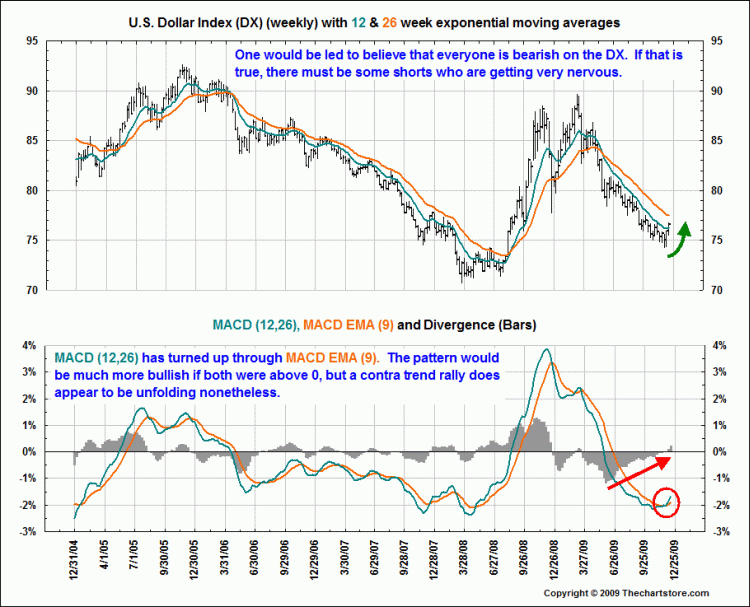
Dollar Rally !


Dollar Rally !

We know that “Short the US Dollar” has been a crowded trade for soem time now. And, after falling 41% from 2001 to 2008, the fat part of the collapse has already happened.
Will it continue? That’s what today’s chart looks at.
How likely is it that the rest of the world will stand idly by and allow:  a) US manufacturing competitiveness a huge advantage via weak currency?;  2) Massive US debt to be inflated away through dollar weakness?
Quite possibly not, as other currencies engage in a race to the bottom. The chart below suggests a dollar rally is in the offing:
>

US Dollar Index Weekly with MACD

12-11-09 Weekly DX w-MACD
Courtesy of Ron Griess of The Chart Store

sexta-feira, 18 de dezembro de 2009

Will The Three Trends of 2009 Prevail in 2010?


Will The Three Trends of 2009 Prevail in 2010?
GaveKal Five Corners
Looking back at the past year, we can conclude that three inter-related trends have dominated financial markets: 1) an impressive weakness in the US$, 2) a significant rally in commodities, and 3) a pronounced out-performance of emerging markets, including Asia.Today, these three trends appear to be running out of steam: the US$ has been rallying, commodities have rolled over and, in November, for the first time in what feels like an eternity, the US MSCI actually out-performed all other countries in the World MSCI index. For us, this begs the question of whether the trends of 2010 will prove different to those of 2009? And the answer to that question may be found in the most unlikely of places, namely the Middle-East.
The news that a Dubai World unit would be suspending payments to creditors, was promptly followed by the rumor that two defaulted Saudi groups (the Saad group and the Ahab group) were treating their domestic creditors differently than foreign banks. From our standpoint in Hong Kong, all these bleak headlines lead us to ponder how the Middle East could find itself in this tight spot? After all, who, a decade ago, would have bet on Dubai (soon to be followed by Venezuela?) going bust with oil at US$80/bbl?
Of course, the apparent squeeze may be nothing more than a few bad apples that blatantly mismanaged their liabilities and blew up their balance sheets. But we have to admit that we are also intrigued by the recent announcements that some of the region's sovereign wealth funds (Qatar, Kuwait...) have lately been selling the large stakes they acquired in Western financials at the beginning of last year's financial crisis. Of course, these disposals may be the result of a deep relief that the banks are back above their purchase price and, like a money manager who has just been on a gut-wrenching ride, the SWF are happy to turn the page and put this episode behind them. Or perhaps, the sales are an indication that the Middle East needs US$ right now and that we are now confronting some kind of squeeze on the US$.
Thus, the recent strength in the US$ may be highlighting that we are experiencing an important change in the investment environment. Indeed, at the risk of making a mountain out of sand-dune, we believe that one thing is for sure: recent developments in Saudi and Dubai will most likely give pause to foreign banks looking to expand their lending operations in that region. And if financing for projects becomes more challenging, then this raises the question of whether the Middle East will look to pump more oil in a bid to generate the revenue necessary to keep the wheels churning? Could an unfolding financial squeeze in the Middle-East lead to the kind of massive cheating on OPEC quotas that we witnessed in the 1980s?
Of course, a proper financial squeeze in the Middle-East, one that triggered a US$ rally and lower oil prices, would de facto justify the Fed's decision to keep interest rates low for a long time. With lower oil would come lower inflation expectations, while a higher US$ would help keep the US economy from overheating under the twin stimulus of lower oil and low interest rates. But where would all this leave other emerging markets, most specifically Asian equities which have soared in the past year?
Historically, Asian equities tend to struggle when the Dollar rallies as a strong US$ forces Asian central banks, who typically run pegs or managed floats, to print less aggressively. But at the same time, most Asian economies would likely welcome the extra liquidity that lower oil prices would provide, not to say anything about an environment of continued low interest rates. More importantly, a possible environment of higher US$/weaker commodities would likely lead to a massive rotation within the markets away from commodity producers and property developers (the key beneficiaries of an ever falling US$ and big components of Chinese indices), and towards manufacturers and exporters (whose margins have been caught between the rock of weak US demand and the hard place of rising materials costs). In other words, a reversal in the weak US$/strong commodity trend would likely trigger a rotation away from 'price monetizers' towards 'volume monetizers'.

Ricardo, Schumpeter or Malthus?

by Charles Gave
We are today very fortunate in having a very broad, highly diversified client base with readers in over 40 countries and in all sorts of businesses, from property developers to mining companies, and of course hedge funds, mutual fund companies and pension funds. We are not bringing this up to brag but because, over the years, we have noticed that, regardless of their locations and underlying businesses, investors tend to fall into one of three categories:
  • Disciples of Ricardo: The law of comparative advantage, as first described by Ricardo, guarantees an optimal distribution of labor and capital between countries, and thus a very good growth rate for profits. This is true as long as comparative advantages have not been fully exploited. And, of course, the one part of the world where Ricardo's law of comparative advantages is just beginning to have an impact is, of course, emerging markets (for example, see The Bullish Growth in China's Road Infrastructure). Thus, 'Ricardian investors' tend to be very biased today towards emerging markets.

  • Disciples of Schumpeter: For Schumpeterians, the source of high returns can be found in the influence of the entrepreneur/inventor and breakthroughs in technology. Such investors tend to favor knowledge-based companies (we have called these platform-companies), and usually carry overweight position in tech stocks, healthcare stocks and other growth stocks.

  • Disciples of Malthus: For such investors, commodities cannot not be in short supply over time given the growth of the world's population and of overall global incomes. Commodity prices will thus have to rise given that we are confronting a world with too many Chinese/Indians/Asians... and not enough oil/copper/gold/iron-ore etc... For Malthusians, the solution is thus simple: load up on commodities or commodities producers or load up on gold and stay outright bearish of most asset classes. Most of the perma-bears (as opposed to cyclical bears) we have met over the years tend to be disciples of Malthus.
In our opinion, to reach a diversified position, one can build a portfolio on Ricardo and Malthus, on the assumption that rising living standards in emerging markets will lead to a structural rise in prices of many commodities. And while history does not support such a view, it still makes plenty of logical sense.
Alternatively, to capture the returns available in the 'volume' growth part of the capitalistic system, rather than the 'price' part, one can build a portfolio focused on Ricardo (emerging markets) and Schumpeter (tech and platform companies). This happens to be the portfolio we have been recommending for some time (thereby highlighting our own biases).
But building a portfolio based on Schumpeter and Malthus makes no sense. Schumpeter and Malthus are mutually exclusive (which may explain why our very Schumpeterian book, Our Brave New World, was so poorly received by the various Malthusians we know?). Indeed, Schumpeterians will tend to believe that 'necessity is the mother of all inventions' and have unlimited faith in the human spirit. Malthusians, meanwhile, will take a much darker view of things.
Take today as an example: inventors across the globe are feverishly trying to discover ways to break the stranglehold on growth created by commodity shortages, especially on the energy front (from more efficient cars, to new forms of energy generation, etc...). If they succeed, the Malthusian values will quickly disappear. If they do not, then one should become very bearish about long-term global growth prospects. After all, we would essentially enter into a very dangerous world where the producers of commodities would likely be instructed by political powers to keep materials for the local population. The world would rapidly become quite inhospitable...
The interesting point is that this year, these three sources of value (emerging markets, technology, materials...) have all risen at the same time, and by more or less the same amount. This cannot last. At some point, one or two of the forces will have to pull away and one will be left trailing behind. On our side, we continue to believe that the long-term bet favors Ricardo & Schumpeter over Malthus.

China's Two Turning Points

by Arthur Kroeber
Over the course of the past year, we have witnessed:
  • The first global economic rebound which was not led by the US. Instead, the 2009 economic rebound finds its root in China.
  • For the first time in China's 30-year reform era, export value fell for the year.
  • In spite of collapsing exports, China will most likely be the only G20 country to grow faster in 2009 than it did in 2008.
So how did China do it? And how sustainable is this miraculous Chinese economic expansion? As almost everyone knows, Beijing has plugged the growth gap triggered by falling exports through a massive ramp-up in public infrastructure spending. And of course, rapid investments in public works have come with their fair share of friction risk, most notably corruption which in turn have led to a rapid rise in the fringe assets used to hide shady money (high-end HK real estate? Chinese art? Gold? Macau gambling...) and to a growing clamor that China is rapidly becoming a massive bubble.
Having addressed these fears in numerous papers (see How China Got Here & Where is China Heading?), we would like to focus instead on the fact that exports will never again be the driver of growth that it has been over the past two decades. From 1989 to 2008, exports grew at an annual average of +19%. This growth was divided into two distinct phases: 1) up through 2001--a dividing line that coincides with both China's entry into the WTO and the start of the American housing bubble--Chinese exports grew at +15% a year, and were highly cyclical; 2) in 2002-08, they grew at an astonishing +27% a year, with no cyclical dips. This year, exports are estimated to fall (for the first time in China's three-decade reform history) by around -15%. Even after the global economy recovers, it is unlikely that exports can sustainably exceed +8-10% growth per annum, given the very high base, and the weakness of the rich economies. In short, future export growth will be less than half the average of the last 20 years, and less than a third of the past seven years.
Aside from the roll-over in exports, China's second important turning point is a bit further off, but is no less crucial. For the entire three decades of China's reform era, the dependency ratio--the ratio of people of non-working age to those of working age--has been falling, from a high of around 80 dependents per 100 workers in the mid-1970s, to under 40 today.
As in the other high-growth Asian economies before, a falling dependency ratio resulted in a higher saving rate, which enabled large investments, and an abundant labor force, which kept wages low. By 2015 at the latest, this ratio will start to rise because of the aging population, and the "demographic dividend" will turn into a demographic tax. The saving rate will begin to come down, the labor market will get tighter, and real wages will start to rise more sharply. A tighter labor market and upward wage pressures were already in evidence by 2007, and will re-appear quite soon once the impact of last year's financial crisis fades.
These two turning points in the export sector and demographics mean that China's traditional growth model--which relied on favorable demographics, rapidly expanding exports, and capital deepening--is nearing its use-by date. Future growth will be slower, and its nature needs to change in order for the economy to avoid running aground altogether. Real annual GDP growth averaged nearly +10% over the past thirty years. For the next decade or so an annual growth rate of +8% is sustainable, and at some point in the 2020s--when China's economy will be about three-quarters the size of the US economy--the growth rate will slow further, to +5% or so. But what will all this mean for financial markets and investors into China's high growth economy? For the answer to this question, see the next section.

Why Invest in China Now?

by Louis-Vincent Gave
In spite of a record pace of economic growth, the returns of Chinese equities for buy and hold shareholders have, thus far, been fairly paltry. For example, since the launch of the H-share market in 1994, investors in the HK listed Chinese companies have massively underperformed owners of Italian government bonds (who would like to take the bet that over the next 15 years, Italian bonds once again return almost 80% more than Chinese equities? Very few investors would knowingly take that bet though interestingly, a number of large pension funds, insurance companies and other long-term investors today own more PIGS gov't bonds than Chinese equities!).
jmotb121409image001
There are, or course, a multitude of reasons behind the inability of Chinese equity markets to monetize the impressive growth of the domestic economy. But chief amongst them must be the capital intensive nature of China's growth thus far. But now, given the challenges presented by the demographic shift and the slowdown in exports, China has no choice but to make the transition from an economy driven by growth in factor inputs (capital and labor) to one driven by efficiency and productivity improvement.
In the past, China has gotten a lot of efficiency and productivity improvements courtesy of its booming export sector. But now, as export growth slows, more homegrown efficiency and productivity improvements are required. In the broadest terms, this requires three main policy directions:
  1. The efficiency of capital, which is quite low, must be dramatically improved through a comprehensive reform of the financial system and the development of robust capital markets. Very encouragingly, this is happening. Hardly a week goes by without the announcement of some financial reform, whether it be attempts at creating a domestic corporate bond market, creation of consumer finance companies, emergence of SME lending desks at banks, launch of the Chi-Next market in Shenzhen, etc (see What Will 2009 Be Remembered For? and It's Different this Time).

  2. Second, fragmented and distorted domestic markets must be knitted together and deregulated, in order to give private entrepreneurs scope for productive investments other than steel mills and upscale housing developments. To some degree, this is also happening and, as deregulation unfolds, it offers up tremendous opportunities for long-term investors.

  3. Finally, the country's parlous fiscal system must be overhauled so that governments at all levels focus less on big capital-spending projects and more on the provision of public goods. In our view, this is the greatest challenge that Chinese policymakers face today.
In short, the immediate rebalancing requirement for China is not so much to reduce the rate of investment, but instead to increase the efficiency of investment. If this is achieved, then substantial increases in household incomes, domestic consumption, and returns on invested capital for investors will follow. The bull market which now seems to have started would then be very long lasting, and churn out an ever increasing number of opportunities. It is our belief that China's economic transition will generate exciting investment opportunities, and hopefully, attractive returns for investors. At the very least--better returns than PIGS debt!

Categorizing Europe's Weakest Sovereigns

by Gavin Bowring
The recent scares in Dubai have re-ignited fears of sovereign defaults and the spotlight has once again been cast on Europe's problem countries. These can be split into two categories: (1) those within the core EU; and (2) those from CEE and fringe countries, the latter being much less economically developed, and often fraught with troubled domestic politics. Here are some factors worth considering for the two groups in determining the degree of bearishness one should have on individual creditworthiness:
(1) The CEE & Fringe Countries: The ECB this week warned that Baltic states risk being "sucked into a second debt-fuelled economic crisis" if their governments fail to impose adequate austerity measures (see Bloomberg). This may simply be posturing by the ECB (Latvian and Lithuanian foreign reserve levels recently hit record highs, possibly as a result of external aid--see Light in the Latvian Tunnel?), however the Baltics' insistence on maintaining Euro pegs means they remain a high risk. Going forward, in many other CEE countries, political risk will play a huge factor in determining the efficiencies of budget allocation. Already there are concerns--in Romania, heightened political risk over recent disputed election results could further delay commitments to budget reform (the IMF has suspended a US$30bn loan to Romania, in turn putting further pressure on the budget and current account deficits). In Hungary, investors are worried that elections next year could spell victory for an opposition which has forecast a 2010 budget deficit of twice the target approved by lawmakers...
(2) Euro-Area Countries As is well known, the biggest problem economies in the Euro-area are Ireland, Spain and Greece, all of which are mired in debt and economic malaise. The Irish economy, with a debt-to-GDP ratio forecast to rise from the current 66% to 96% by 2011, is obviously in miserable shape, but at least the government appears willing to take painful and politically risky measures--massive wage cuts and income reductions are being implemented across the spectrum, in tandem with proposed tax increases on income and levies on public sector pensions (see details of tough 2010 budget here). In Spain and Greece, by contrast, the governments still appear resistant to hard choices that might help them tackle their debt, which in Greece's case is forecast to rise from the current 112% to 130% of GDP by 2011. Within weeks of winning the country's elections in October, the Greek socialist government raised the budget deficit forecast to 12.7%, twice the previous government's forecast. Spain's debt to GDP ratio at 55% is below the European average, but it is suffering the ongoing effects of a major housing bubble implosion. Yet unit labor costs in Spain rose +0.4%YoY in the third quarter despite an 18% unemployment rate. More worrying are the fears that European banks in general and Spanish banks in particular have been slow to write off bad assets (how could Spanish banks have managed to largely avoid Spain's massive housing bust?).
With these concerns coming to the fore, we believe the European Divergence Trade is back on. We also expect such concerns to provide another reason to sell the Euro vs the US$, though the coming decline of the Euro from the current very overvalued levels will not provide countries like Ireland and Greece much relief in the near future. After all, in terms of their real effective exchange rates, these two countries, along with Spain, have appreciated the most in the past decade.
jmotb121409image002


image
John F. Mauldin
johnmauldin@investorsinsight.com
image

Minha lista de blogs