The big question in every one's mind is did yesterday mark the end of the bear or at least the end of this leg down?

The big question in every one's mind is did yesterday mark the end of the bear or at least the end of this leg down?
LAURA MATTOS
da Folha de S.Paulo
Nenhuma cirurgia plástica ajudou Adalgisa Colombo, 68, a ser escolhida Miss Brasil em 1958 nem a ficar em segundo lugar no Miss Universo. "Naquela época era proibido até usar cílios postiços", conta.
| Adrees Latif /Reuters |
![]() |
| 57º Miss Universo, que será no Vietnã, terá como representante brasileira Natália Anderle |
Mas ela tinha seus truques. "Um maquiador colocava pancake [maquiagem que tira o brilho da pele] nas pernas das misses, que ficavam todas brancas. Aí me disseram: "Vá ao banheiro, lave com água e sabão para tirar e passe óleo Johnson. Aquilo, com as luzes, dava um brilho... O que tinha de miss e mãe de miss querendo me matar... Eu também descosturava um pouco o maiô para deixá-lo mais cavado", lembra Adalgisa, eleita Miss Distrito Federal, na época o Rio de Janeiro.
É um concurso totalmente mudado, com misses que se submetem a mais de dez plásticas, que Adalgisa irá comentar hoje (13), a partir das 22h, durante a transmissão na Bandeirantes.
O 57º Miss Universo, que será no Vietnã e exibido ao vivo também pelo canal TNT, terá como representante brasileira a gaúcha Natália Anderle, 23.
Ex-empregada doméstica e babá, a Miss Brasil não gosta muito de falar no assunto, mas sites de fofoca dão conta de que já colocou silicone no bumbum e nos seios, usa capa de porcelana nos dentes, fez lipoaspiração e tirou duas costelas para afinar a cintura.
Adalgisa não condena a nova geração: "A cirurgia plástica é a invenção do século! Eu já fiz tudo o que você imaginar. Se a moça é linda e tem orelha de abano, por que não corrigir? E se for um bagulho, nada resolve, só se colocar numa máquina de moer carne".
Adalgisa comentou o Miss Universo na Band também no ano passado, quando a mineira Natália Guimarães perdeu o título para a japonesa Riyo Mori, em uma final polêmica.
"O título foi roubado dela e do Brasil. Foi parecido com o que aconteceu comigo, que perdi para uma colombiana. Só para você ter uma idéia, ela media 1,58 m e eu, 1,70 m. Dá para entender?", questiona Adalgisa.
Já no TNT, a comentarista é de uma outra geração. Em 1993, com uma plástica no nariz, Leila Schuster foi Miss Brasil e ficou em sétimo lugar no Universo. "Naquela época, a gente não falava sobre isso. Depois, fazer muitas plásticas virou até marketing. Agora, com as críticas às "misses plastificadas", houve um recuo, e elas não querem mais contar que cirurgias fizeram", analisa Leila, 35.
Ela aposta que Natália possa ficar entre as cinco finalistas, mas admite que "a venezuelana e a mexicana são páreo duro".
Com candidatas de 80 países, o Miss Universo será comandado da cidade de Nha Trang pela cantora Mel B (ex-Spice Girl) e pelo apresentador Jerry Springer. Na Bandeirantes, a apresentação fica com Renata Fan.
| Divulgação | ||
![]() | ||
| Ex-babá gaúcha Natália Anderle, 23, disputa Miss Universo hoje (13), às 22h; Band e TNT transmitem concurso |
MISS UNIVERSO
Quando: hoje, às 22h
Onde: Band e TNT; classificação: livre
Global markets
Jul 3rd 2008
From The Economist print edition

THEY rarely ring a bell at the bottom of bear markets. Investors who thought they had heard a tinkling sound when Bear Stearns, a failing American investment bank, was bundled into JPMorgan Chase in March have been disappointed. The Dow Jones Industrial Average is now weaker than it was in the spring (see chart).

The American stockmarket had its worst month since 2002 in June and is now down more than 20% from its peak, the definition of a bear market. It is not alone. According to Standard & Poor’s, a rating agency, the value of global stockmarkets fell by $3 trillion during the month, thanks in particular to a 10% decline in emerging markets.
Share prices are suffering because of the outlook for four forces that impel stockmarkets: economic growth, profits growth, interest rates and inflation (see article). At the moment, the first two seem to be slowing while the last two are rising. That is the worst possible combination.
Soaring oil and food prices are stoking inflation. Oil closed at another peak of $144.14 a barrel on July 2nd, because of disappointing data on American crude reserves, and lingering fears that sabre-rattling between Israel and Iran might lead to conflict in the Persian Gulf. High commodity prices have also acted as a terms-of-trade shock for consuming countries—the things they buy from abroad cost more compared with the things they export. That has made them poorer.
The past six months could be seen as a dreary exercise in sharing out the pain. Will workers suffer by seeing their wages rise more slowly than inflation? Will companies have to compensate their workers by raising wages, sacrificing their profit margins? Will central banks treat high commodity prices as a blip, and leave real interest rates low, penalising savers? Or will they raise interest rates and risk pushing the economy into recession? None of these choices is palatable.
All this has been made worse by the credit crunch. True, the rescue of Bear Stearns seemed to avert the implosion of the financial system. Credit spreads, which measure the excess interest rate paid by riskier borrowers, have fallen from their March peaks, although they have recently been rising again.However, the crunch continues to chew its way through the system. Its effects can be seen in the sharp falls in mortgage approvals in both America and Britain. And it can also be seen in data produced by the Federal Reserve which show that loans made by banks (their assets, in the jargon) have fallen over the past three months.
This tightening in credit has taken so long to show up in the numbers because of the way that banks were operating before the summer of 2007. First, they had pushed much of their lending business off-balance-sheet, so that loans were bought by specialist entities like structured-investment vehicles (SIVs) and conduits. When the market for subprime loans collapsed, a lot of these loans came back on to the banks’ balance-sheets. Second, banks had made back-up commitments to businesses to lend money if needed. With the collapse in other debt markets (such as asset-backed commercial paper), corporate borrowers cashed in those chips. Much as they would have wished otherwise, banks found their loan books expanding.
Now, chastened by the huge amounts of capital they have had to raise to strengthen their balance-sheets, banks are being more careful. According to Ian Harnett of Absolute Strategy Research, a consultancy, the availability of credit in Europe for both consumers and companies is now at its lowest level since 2003.
The problem for financial markets is that the virtuous circle which pushed asset prices higher in the middle of this decade may be turning vicious. Banks lend money against the collateral of assets, most notably in the form of housing. As house prices increase, the collateral rises in value and the banks are willing to lend more. That enables buyers to bid up prices even further.
But when banks stop lending, buyers are unable to purchase assets. Some investors are forced to sell to pay off loans. The value of collateral falls, making banks even more reluctant to lend. Markets freeze up, as neither buyers nor sellers have the confidence to do business.
As house prices fall in America, Britain, Ireland and Spain, the wealth effect kicks in. George Magnus, a strategist at UBS, cites the examples of Finland and Sweden in the early 1990s. As house prices fell, personal-savings rates jumped by 12-14 percentage points. A similar move in America or Britain would have a devastating effect on consumer demand, and thus on GDP growth over the next couple of years. As yet, there has been more of an effect on consumer sentiment than actual retail sales, although individual retailers (such as Britain’s Marks & Spencer) are suffering.
As for companies, with consumers depressed and banks unwilling to lend, why should they invest? They may still see exports as a source of economic growth, but that works only for some firms in individual countries, not for those in the world as a whole.
So the market’s sorrows have come in battalions, not single spies. Investors might have coped with the credit crunch if it were not for the high commodity prices, and vice versa. They do not know whether to fear inflation or recession more, but they know that both at once will be unpleasant.
It looks like a lengthy period of gloom is in store for the stockmarkets. Meanwhile, the best investors can do is hope, Micawber-like, that something will turn up. A collapse in oil prices would help.
Happy Birthday, America!
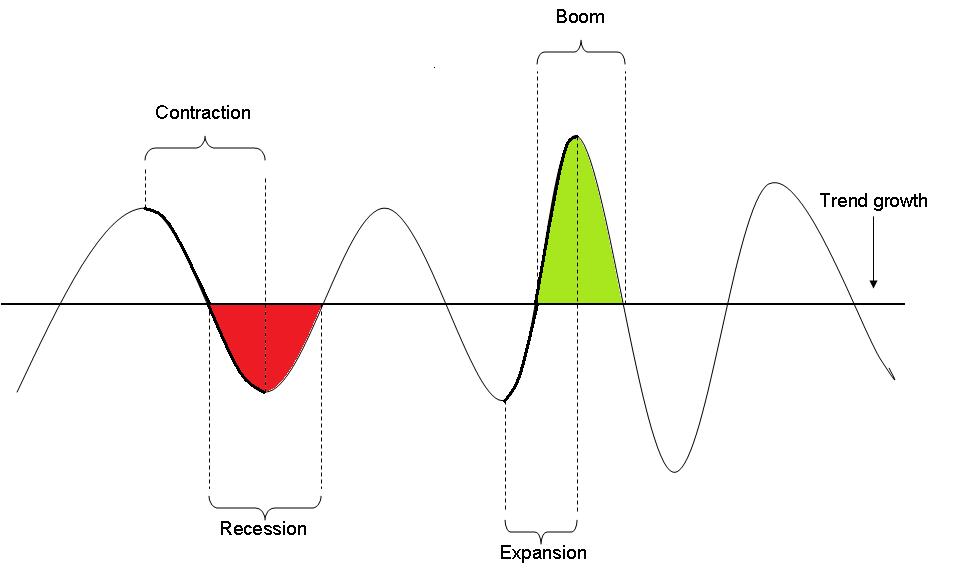
The typical economic cycle consists of two main phases: Boom and Recession. The phase leading to a boom is called expansion and that leading to a recession is called contraction. Another way of looking at this is considering expansion the transition from recession-boom and contraction the transition from boom-recession.
click to enlarge
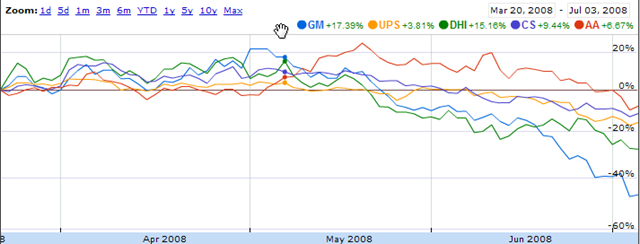
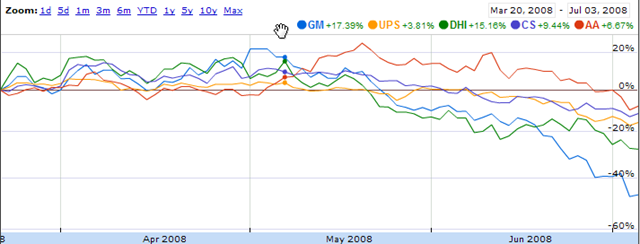
10 signs that an economy’s in recession:
The trending in the first 5 sectors looks bleak. Are we really doomed?
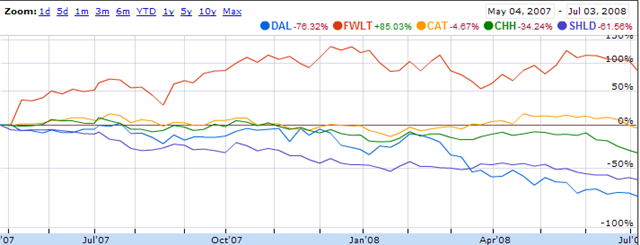
Remember I said there are 10 signs. Let’s look at the next 5 signs and then discuss the recession for real:
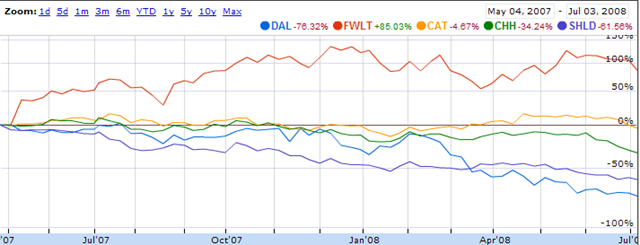
Looking at the chart above, it’s obvious that FWLT and CAT are trending down but are the only ones not in the red yet. This is semi-good news. There’s still some expansion going on in industrials and agriculture – this indicates that we are in the contraction mode of the cycle and are currently looking at imminent recession. However, I’m hoping that corrective measures are taken before this situation actually spirals out of control. What corrective measures, you may ask?
First and foremost, there should be an increase in the short term interest rates. This will help in 3 immediate ways:
I believe the Fed would have increased interest rates already had they not been pulled into salvaging and saving the banks caught in the quagmire of the subprime crisis.
The chart below shows whenever the economy’s been in a recession historically (see 1980 or 2000), an increase in interest rates has had an ameliorating and rejuvenating effect on the market. The Y2K downturn was converted into an upswing in 2003 through the increase in interest rates. It’s time we saw an increase in both interest rates and the market versus inflation, for a change.
Today’s economies are global and the US has a lot of things to go manage at the same time (fix the $, inflation, deficits, energy demands etc.). Just increasing the interest rates may not be the silver bullet anymore. It’ll require a series of steps besides that, such as the bursting of the energy bubble.
What do you think?
Making money in the US and Canadian stock markets requires that an investor constantly buy and sell company stocks.
Below are my 20 guidelines an investor should consider when trading in the stock markets;
Disclosure: I have stocks in COS, SPF, TUI, AET, ERF, TIM, PEG/, PQC, PBR, GMR, PEA, QEC, CCO, CLR, DDV
I forgot to mention yesterday that some recent comments were picked up in Barron's The Trader column this week:
"While the bear market could persist (as this week's cover story warns), the stock market's worst June in 78 years -- and its worst first half since 1970 -- have encouraged bargain hunters looking for at least a short-term bounce.
They were egged on by a few signs: Large-cap indexes have fallen decisively to fresh 2008 lows. Energy and material stocks, the last bastion of strength, have begun to crack, and even the high-flying Market Vectors Coal exchange-traded fund (ticker: KOL) has plunged more than 15% over the past three trading days. NYSE volume reached 5.8 billion Tuesday, almost matching the decisive 6.1 billion seen at the mid-March bottom. The crop of NYSE and Nasdaq stocks scraping year lows swelled above 1100 midweek, approaching mid-March's 1236 tally.
A pronounced spike in investor fear, matching levels seen in January or March, is no guarantee of an enduring rally, as recent selling wiped out the year's gains. But traders hoping for the kind of climactic purge that marks a stock-market bottom remain disappointed by the almost-but-not-quite-there cues. Option-market sentiment gauges also remain unruffled. "I would have thought the most recent drop might have frightened investors just a tad," notes Barry Ritholtz, director of research at Fusion IQ. "Instead, the bottom callers were out in full force. There is still a whole lot more greed than fear."
Always cool to get in The Trader column . . .
>
Source:
The Bear Arrives -- With Bargain Hunters
KOPIN TAN
BARRON'S, JULY 7, 2008
http://online.barrons.com/article/SB121512457376427985.html